5 Things Foreigners Like Me Might (Might) Not Know about Oktoberfest

“I see that this post is dated October 27(ish). Oktoberfest ended like, 3 weeks ago. Don’t you think you’re writing this a little-”

Don’t worry about it. I promise you that today is not what everybody’s saying it is–something like the 27th. It’s the 6th. Yeah. The 6th.

Coming up with a good excuse to write about Oktoberfest and post videos and pictures of it is turning out to be a little tough. We didn’t see any epic fights, nobody in our group had to square off with security, and nobody got drunk enough to seriously injure their self. So here’s a “5 things” list. 5 Things Foreigners Like Me Might (Might) Not Know About Oktoberfest.

1. We are all animals. I realized this during my second day “on the Wiese” (as all the cool kids say it). We went early in the morning, even before most people were drunk, to meet some friends from other German cities and the Netherlands. Schottenhamel was our destination. We get there, and the line to get in is wrapped around the whole building. But, I can see friends Daniel and Alvaro a ways up in line. Because of what it takes to get into one of these Zelte, people who cut in line undoubtedly have a special ring in Hell reserved for them, so that was out of the question. I did want to go say “hello,” though, so up I went.

Daniel and Alvaro are grinning, and I go to shake their hands. “Hey, what’s going on, g-”

Someone on my right shoves me so that I bounce a few yards to my left. “Go!” yells a squat man, maybe 30 years old, with shoulders that touch his ears. “You can’t be here, get away from him!”

I’m standing next to a line in the middle of public, so I’m not out of bounds, or anything. He seems to be trying to prevent me from cutting in line. Maybe tons of people do that.

“Sorry, man. I was just saying hello to my-”

“Go, now!” Now, he’s approaching me. His nostrils are flared, and he’s wearing his brow like a welding visor.

Yikes, better leave. “See you guys inside,” I tell Daniel and Alvaro, and then I head back to the line where Roxana has our place.

At first, I thought that guy was just a rogue turd basket taking his bad day out on Oktoberfest attendees. I now think differently, because that kind of behavior is definitely a trend among the event’s security reps–pushing, moving in your way until you throw away your outside drink, dragging you down from a table and pushing you outside. It all seems pretty intense. But, I think they do it for a reason.

Oktoberfest is 17 days of insanity wrought by about 7 million attendees from all around the world. The normal population of Munich is about 4 million, and it would seem that a sizable chunk of the local population go on vacation during Oktoberfest. Many of those attendees are drunk the entire time. If I’m working security at an event like that, then I’ve probably seen things, man. Thing I dream about when it’s cold and rainy outside. And maybe part of me is terrified of doing this, again.

2. There’s an entire weekend (unofficially) devoted to Italy. It’s called “Italian Weekend.” During that weekend, Italy comes to Munich, and all the Germans I know stay home. That’s all I know about Italian Weekend.

3. Schottenhamel and Hippodrom are the “Zelt” names you should know. “Zelt,” according to Google Translate, is the German word for “Tent.” Google Translate is known to drink itself into an incomprehensible stupor when you ask it to reconcile German with English, though, so I’m not sure a German tent is the same thing as a rest-of-the-world tent. Two reasons I think this:

a) “Hey Googs, what up!? Have a question for you, man. My sister just had a baby, and I want to tell my German friends about it. What do I say?”

(Hiccup) “Hey, man! You’re the guy! Sure, I’d love to…um…help!” (hiccup) “Well, um…” (hiccup) “you might try ‘Meine Schwester hatte ein Kind.'” (hiccup)

I’m squinting, trying to figure out if I should trust him. “Um, okay Googs. I’ll see what happens.”

—1 day later—

“Thanks, jerk!” I say. “Do you know how sad everyone got when I told them what you told me to say?”

“Duuuuuuuhhhhhhhhhhh…”

The problem with what I said is that, in German, you say “Meine Schwester hat ein Kind bekommen,” not “Meine Schwester hatte ein Kind.” Google told me to say “My sister had a baby,” when Germans really say “My sister received a baby.” The natural question that follows my announcement is “Oh my God, what happened to it? Where’s the baby, now?”

So I never trust Google with my German questions.

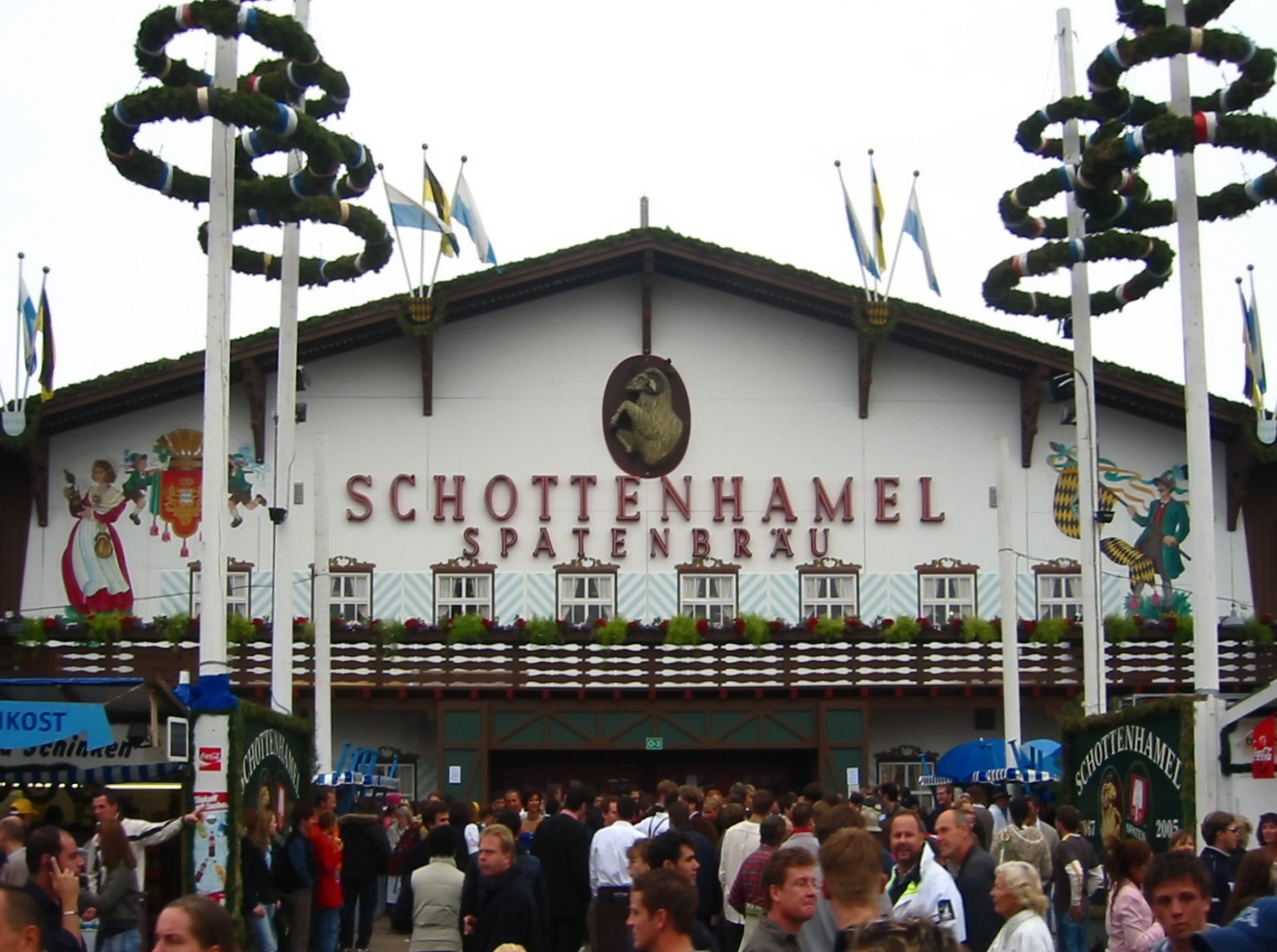
b) A “Zelt” looks like this:
Image

Would you call that a “tent?”

Anyway, you should know what Schottenhamel and Hippodrom are before you go to Oktoberfest. Schottenhamel is the rowdy Zelt, while Hippodrom is the classy Zelt. Here, what “classy” means is that people are more or less in their seats the whole time, and fewer people are ever at risk of drunkenly stumbling off a balcony.

We went to Hippodrom with some friends who had reserved a table about a year ago. The tables are just big enough for 8 people to sit at them, the inside of the tent is filled with bright colors and statues, and the band is elevated above the ground floor on its own platform. Most of the people there seemed to be making the evening all about simply talking and drinking with their group of friends, and one of my German friends is of the opinion that that’s mostly how things go at Hippodrom. Here are some views of the inside from our table:
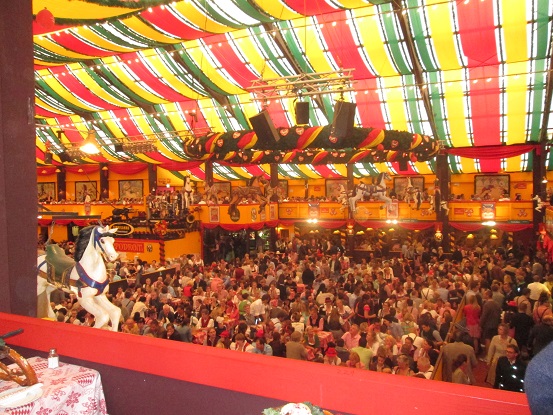
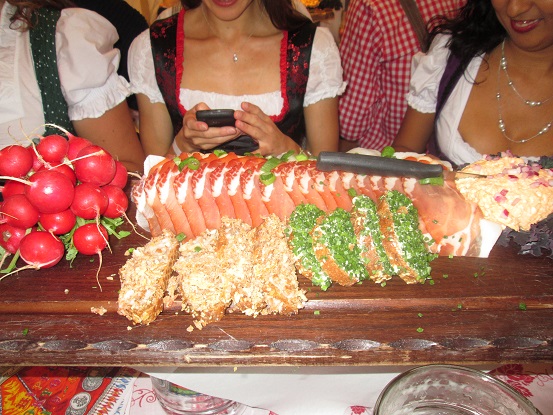
IMG_1304IMG_1309

Shottenhamel, on the other hand, is more of a party-with-randos tent. We were there for 3 hours in the morning (9am-noon), and it was definitely rowdier than Hippodrom. Maybe 20 minutes after we sat down on the second floor, a guy a few tables down climbed up onto the railing and lifted his glass, looking around. Instantly, everyone around us began cheering and chanting for him to drink his whole liter of beer without a pause. He started, and kept drinking as the cheering turned into an excited roar. Halfway through, two of those big security guys from before showed up and tried to drag him down from the railing. But, the guy wasn’t ready to leave. He finished chugging the beer while fighting off security with his free hand. Finally, he finished the beer, and the crowd roared approval while security dragged him down the steps and threw him out of the Zelt. This happened, plus or minus the security guys, about every 20 minutes. Here’s what the inside of Schottenhamel looks like (I didn’t bring the camera that day, so here’s something from Google images):
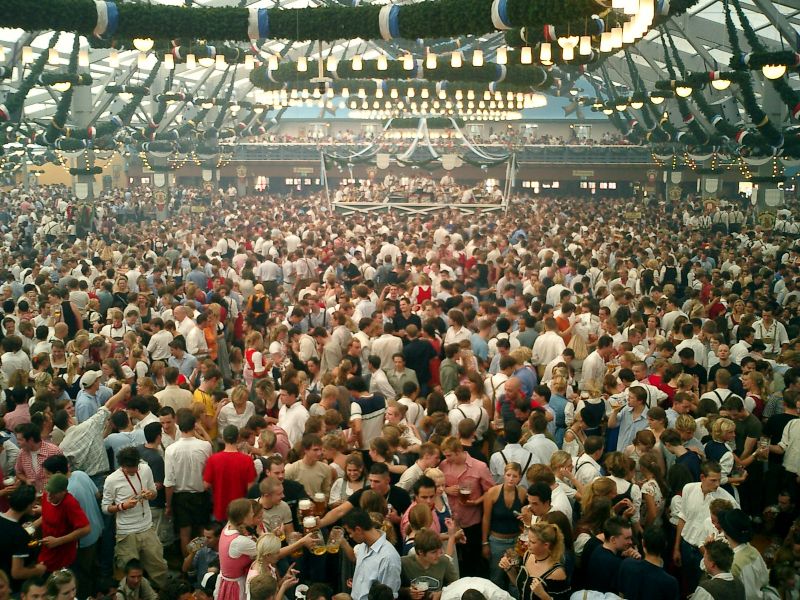
schottenhamel-2

4. You can only get into most “Zelte” with reservations–months to a year in advance. I don’t have much to say about this, except that we’re extremely lucky that our friends had space free at the table they reserved a year ago. This is just something you should know before you go–it’s never too early to try to get seats in a Zelt.

5. Oktoberfest is when Munich lets itself go absolutely nuts. A friend of mine was yelled at by his neighbor when he threw his garbage in the dumpster at 8am, because it made too much noise. Housework on Sunday is illegal for the same reason. Walk around the city during the week, and you see people passing the time simply by sitting and looking at one another. Or, they’re in a park, lying on the grass. And that’s it. If it’s the end of September, though, and you hear this song, then you’d better pick up your beer and jump up onto a table:

German Class, Die Deutsche Grammatik, and Obamacare

Before I begin, I should probably put out there that a few of the ideas in this post come dangerously close to being political opinions. If you’re allergic to them, then I advise you to evacuate this blog as soon as you can. Alternatively, you can express any dissatisfaction you experience to ohgodforgivemeryan@gmail.com. My people are working on a vaccine against opinions and might be able to help.

Remember when I said that level A German doesn’t prepare a person to speak about politics? Well, week 1 of level B does. Chapter 28 of our book is entitled “die Geschichte,” which literally means “History” and roughly means “holy shit it’s about to get all UN up in here.” So this is probably the best chapter in all of Deutsch lernen.

First, I need to describe my new German teacher.

He’s old in the absolute best way possible. He arrives in his chair at exactly 9am, immediately closing the door behind him to maximize the awkwardness of late arrivals. When you do arrive late, he ignores your tardiness for about 3-4 minutes while he continues with the early exercises he planned for us. At the 3-4 minute mark, he suddenly stops the lesson and peers at you over his glasses, across the table, through your eyes and into the brain of your soul. Then, he says something like “one should always be punctual. When one arrives late, it disrupts the flow of the lesson, and your classmates cannot learn. I cannot say more–you are in  Germany, the land of punctuality.” That’s what he actually said the first time someone was late. Well, he said it in German, so it’s very nearly what he actually said.

He is literally tied with one other person for “the greatest teacher I have ever had.” I enrolled in all three of the other guy’s classes in college.

Additionally, I wouldn’t call what he does “teaching.” Rather, he forces knowledge directly into your brain. Looking over the top of his glasses, he starts with a seemingly innocent question. Seemingly. In reality, he carefully crafted it using as many as possible of the parts of grammar we’ve learned so far.

“Ryan, ask Carolina what she discusses with her friends when she meets with them.”

Then I have to make a question out of that. “Carolina, what do you discuss with your friends when you meet with them?” That particular question is actually insane when all you know is A-level German.

And then “Fernando, what did Ryan just ask Carolina?”

Fernando then has to say “Ryan asked Carolina, ‘What do you discuss with your friends when you meet with them?'” And that sentence just destroyed Fernando’s brain, because it  requires a very non-intuitive change to the “What do you discuss…” part.

And then “Stephano, say what Fernando just said in the past tense.”

And it proceeds until we’ve exhausted every tense and every construction of that original sentence we know.

His name’s Valentin, and he’s come to teach you some goddam Deutsch.

So here’s the part about Obamacare.

We’ve hit some heavy subjects in the “Geschichte” chapter. We’ve celebrated the fall of the Berlin wall and the reunification of Germany about a billion times (Der Tag der Deutschen Einheit was yesterday, as a matter of fact). We’ve admired George senior for flying a plane against the Nazis in WWII, and we’ve even discussed the motivation behind Hitler’s “final solution” (“nobody really knows” is among the million or so theories we discussed for that last one).

Today’s discussion falls in the middle of the intellectual-weight continuum described above, closer to “Berlin Wall” than to “Final Solution.”

During a listening exercise, we were supposed to select from a long list of key phrases the ones discussed during a set of interviews. One phrase was “eigene Kultur” (“unique culture”). The interview that brought it up did so in order to say that Europe’s culture is amazing; it’s just kind of a shame that so much has been Americanized over the recent years.

Afterward, Valentin took a break to open up a discussion. He said that the statement in the interview, while just for educational purposes, did have some interesting relevance to it. He said that American movies and music, especially, seem to be preferred in public settings over their European counterparts. Since entertainment is a vehicle for culture, it makes sense that a trend like that would inject American culture into Europe. He said that some countries are even taking steps to ward it off. France, for example, requires that 50% of music played on the radio is of European (possibly even just French?) origin. I don’t know if that’s law or just social, or if it’s even all of France–he didn’t go into too much detail about it.

Next, he expressed a little disappointment that entertainment might inspire Europeans to emulate Americans, when that would be a fallacy in judgment. Europe is not America, after all. He then put an idea in our heads for us to consider–perhaps Europe shouldn’t look to America as a role model in light of the congressional impasse that disabled government spending on Tuesday. “Does anyone know about that?” he asked. “Ryan?”

“Yeah, the government isn’t working since Tuesday.” (Ja. Die Regierung funktioniert seit Dienstag nicht.).

“Yes! That’s it. And the center of it all is Obamacare, yes? Democrats want to fund it and Republicans do not.”

“Yeah, that’s right.” (Genau).

His eyes began ascending the lenses of his glasses. Soon, they were out in the open and pointed directly at the innards of my soul. “And what do you think about Obamacare? Is it necessary? Good or bad?” He was smiling. I should really mention that, because he’s incredibly good-natured for all his sternness.

All 22 other faces in the class pointed themselves at mine.

!Political opinion requested! Here, discussions of politics and religion are mostly no big deal at all–every teacher I’ve had has brought them up, and they come up at dinner quite often as well. The American in me had a pulse of about a million beats per minute, though. Ok, Ryan, here goes. Just say something. Opinions don’t always start screaming matches and fist fights, here.

“Well, that’s a really difficult question,” I said. I wasn’t even being a non-committal wimp about that–I was dead serious. “For me, what’s important isn’t whether or not the government should provide healthcare to its citizens. What’s important to me is what the opportunity cost of Obamacare is. If the government funds healthcare (and maybe the medical industry infrastructure to support more patients?), then what can’t it do as a result? Knowing that is how I would decide whether or not it’s ‘good.'”

“Ah, yes, I understand what you mean” replied Valentin. “But the government should be able to provide for its citizens, no?” “What do the other students think?” (Worth noting is that Valentin is native to a country that found a way to enact a 40%+ income tax without a single government building burning down).

The next 2 or so minutes were a calamity of agreeable mumbling, head shaking, and short bursts of contrary opinion. Most of our Japanese-Italian-Bulgarian-Spanish-Argentinian-American-Ukrainian class straight-up said “healthcare should absolutely be public,” while a few were in the pragmatic camp.

If you have a bunch of American Facebook friends and you read your feed the week of September 30, 2013, then you know exactly what the room sounded like.