People Who Will Drive You Nuts: Munich Edition

Nothing on this planet is more selfish, careless or downright evil than a stranger. Am I right? Just think about one of those jerks right now. Who does he think he is? What’s her game, anyway? You’re getting angry now, right? Good.

As I was saying, strangers–the most selfish baskets of turd sandwiches in existence. What’s terrifying is that they live in every city on Earth. Even yours. In Dallas, for example, one such person wastes half of every green traffic light just sitting in front of it in their car. Maybe they’re putting on makeup. Maybe they’re texting. Maybe they’re shaving. Maybe they’re brainless.

In New York, I’ve heard that the most annoying of these jerks are the ones who will cut in front of one or more lanes of traffic just to make a left turn. Waiting a block to turn is for chumps.

This post is about Munich’s brand of jackassy stranger, complete with hilariously rage-inducing photos. The photos aren’t mine, but I’ll tell you where you can find the owner. I thought about photographing these people myself, but every time I try to imagine doing so, this happens in my head:

Selfish Douchebag: “Hey buddy, did you just take my picture?”

Me: (Laughing awkwardly) “Uh, yeah, sort of, I guess.”

Selfish Douchebag: “Why?

Me: “Because you’re being an ass, and I want people to see this on my blog.”

***

Anyway, let’s do this!

1. Person Who Leans on the Pole in the Subway Car

Either start dancing or give us some room. Source: towngrump.wordpress.com
Source: towngrump.wordpress.com

If you’ve ever seen one of the poles in a subway car before, then I don’t need to tell you how awe inspiring they are. For less raw material than it takes to make a car door, you can prevent 7-10 people from becoming human missiles during a train ride. Breathtaking.

Sometimes, though, you encounter a testament to human evolution like the person in the photo on the right. They see all of that tasty surface area and think to themselves “Finally! My entire back has been begging me all day for one of those!” And in their comfort, they never realize exactly how much chaos they’ve prepared to set in motion.

They will, though. All subway cars need to turn at some point, and when theirs finally does, 6-9 people won’t be holding onto anything.

2. Person Who Only Opens One Door of the Subway Car

For a calorie cost more or less equivalent to opening one’s eyes in the morning, you can double the size of the hole in that car, allowing untold numbers of people freedom from their BO prison on rails. If that realization just took your breath away, then you know how I feel. Exactly.

3. Person Who Stands on the Left Side of the Escalator

Source: gadling.com
Source: gadling.com

Very few places in your average developed city inspire hurrying more than underground metro stations. Even in a well-run city like Munich, they all fall on a continuum between two evils: Really, really boring (Feldmoching) and completely drenched in urine (Marienplatz). You want to spend the absolute minimum amount of time possible in those things, is what I’m saying.

Fortunately, you can look forward to the escalator–a time-saving marvel of the modern world. Imagine taking the stairs with the gift of super speed, and you’ve just had the same dream as the inventors of this godsend. Outstanding.

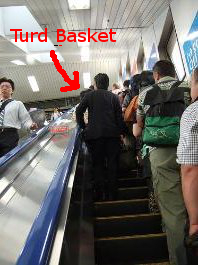
Then, you run into this turd basket. Everyone else is in the most politely organized single-file line you can imagine along the right side of the escalator. They’re making way for anyone who would rather walk their way to freedom from the metro’s bowels. This human blessing, however, is casually spaced out and standing right in the middle of the path they created.

I think the esoteric term for this kind of stranger is “tourist.”

4. Little Old Lady with Jacket and Bag

Little old lady with jacket and bag.
Source: instinctsurvivalist.wordpress.com

She’s older than the average fossil, smaller than the average toddler, and she’s somehow going to be in your way for the next 20 minutes of your walk.

She’s also completely immune to any attempt to get her out of your way. Because, you know. Old. If doing anything in this life causes dead kittens, then harassing little old ladies is one of them.

Being stuck behind one of these will very likely push your heart rate to the brink of time travel. But on the bright side, she’s adorable. So there’s that.

How Education is Different in a Master’s Program Taught by Scientists

My Bachelor was a dual-study in Business Administration and Advertising. Along with Engineering and Journalism, they’re probably two of the most practical academic programs on the planet. That is, they teach you things like these:

1. A fast 80% is often better than a slow 100%

2. Data analysis only needs to inform a decision, not yield The Truth

3. The best idea is the one you can get people behind

Arguably, those insights are really good fuel for success in business. Those programs were exactly what I’d hoped they would be.

After Bachelor, I went to work in Marketing for a large tech company. Those three insights above and a host of others resurfaced again and again on the job. My teachers seem to have known what they were talking about.

My Master’s program is more scientific (put your torches down, natural scientists–I just said “more scientific”). This time around, we’re learning how to beat a dead data horse into the ground in order to conclude exactly how right we can claim we are at the end of a sociological study. You’re only 80% sure that your study didn’t yield a false-positive result? Get back to your political polling, noob. It’s exactly what I’d hoped it would be.

I can stop there, for now. The point of this post is obvious–a Master’s program taught by scientists is a lot different than a Bachelor’s program taught by industry veterans. Here’s how:

1. “How right?” vs. “Not obviously wrong”

In the sciences, your audiences will usually be wondering how right you are–how comfortably they can consider your results an insightful description of something real. The quantitative side of this is obvious–which  test did you run, and how significant are its results? There’s a number there. That’s pretty much the end of the story.

There’s a qualitative side, too. “Which model did you assume?” is one qualitative question. If you assume a linear relationship between a set of explanatory variables and an outcome variable, but the scientific community really thinks the relationship should be exponential, then your study’s a bust. It won’t get published, and your results will never enter conventional wisdom. Theoretically, the correct answer to “how right?” is “100%.” However, I don’t think any scientist will expect that any results are 100% correct, even if the data suggest that they are. Instead, you want to be 90-100% correct. Unless you’re into theory generation, in which case you’re a salesperson.

In school, this means that a successful project results in your thorough understanding of what’s already known. For instance, I’m taking a class called “Value Chain Economics.” It’s microeconomic theory applied to optimizing an industrial chain from start to finish–from raw materials gathering to finished good shipping. Our capstone project is exactly what you’d expect–analyze a value chain, identify its problems, and recommend a solution to one of them. In a business or ad program, we would be expected to gather as much insight as possible and then craft an original solution. Inductive logic usually feeds original solutions, so we’d be applauded for reasonable leaps in logic. In this program, however, one of the questions our graders are going to have is “how can you be sure this will work?” (contrast with a business professor’s “Why do you think this will work?”). This makes looking for case studies that document a solution to the problem a viable strategy.

“How right” rarely seems to matter in business, though. “Not obviously wrong” is what matters. You come up with a theory, get your colleagues behind it, run a program, and then determine and document how well the program performed. That’s where good business knowledge comes from. Plan, execute, evaluate, optimize–that’s the stuff, and it involves a lot of celebrated failure. It works, because it’s fast and, online at least, cheap. If your aim is making people aware that your product can fly, and your marketing plan involves a bunch of networking events and keynote presentations, then your plan might fail the “not obviously wrong” test.

2. A Master’s Student is Not a Student–They’re an Intern

I don’t know if it’s just because we’re not learning the basics anymore, or if it’s because scientist/professors are selfish, but I’m extremely suspicious that most of our projects are meant to help our professors do their jobs as researchers. If they teach us something as well, then hooray for two birds.

In “Conflict Resolution,” we’re supposed to identify a natural resource conflict, analyze it and propose a strategy for alleviating it. Sounds great, right? I still think it does. However, our professor is paying WAY more attention to those of us who chose mining-related conflicts than those who didn’t. And wouldn’t you know it, that’s the subject of her research. What a coincidence! Those poor “whaling conflict” groups.

This may be because the scientist/professor’s career is still active and tied to the university. In my business and ad programs, the professors had to be enticed away from industry jobs to finish out their working days teaching the next batch of young thems. In their case, teaching was their core function, and presumably that’s why our projects back then were extremely educational, but likely had very little use outside of our final classroom presentations (unless the subject companies were looking for ideas).

3. 80%? Are You Kidding Me?

Remember the “Fast 80” insight with which I opened this post? My worldview is informed by that insight to a large degree after Bachelor and those three years at the tech company. It makes an awful lot of sense–you’d be surprised how often you’ve done what you need to do by the time you hit the 80%-of-perfection point. In any case, I think its real value is in reminding us that it’s usually time to wrap up a project before we consider it truly perfect.

This difference is funny, because it affects the way we classmates interact with one another.

Our program probably contains equal numbers of what we’ll call “academics” and “industrials.” Industrials like me plan to continue in the business world after graduating. Academics want to keep doing research and get published. 80% is simply not enough for an academic, and trying to pitch them on the idea will drive them crazy.

An example of an industrial-academic conflict is this: some research says that plastic takes an average of 450 years to degrade naturally when thrown away. Other research says it takes 1,000 years. The industrial thinks “it takes a long time,” and just includes 450 years in their presentation to err on the conservative side. “It takes a long time” is really what the audience needs to know. The academic, on the other hand, needs to know which one is correct, or how it’s possible that both are correct. In a team’s context, as soon as the industrial settles on 450, the academic has a panic attack as visions of a declining final grade flash before their eyes, even if the decline envisioned is a 96% to a 93%.

I’m finding that this dynamic fosters extremely effective teamwork, however. In business school, everyone’s obviously an industrial. On the worst of teams, that leads to a lot of fudging–“eh, it’s close enough” adds up enough times to drive the final result so far away from insightful that the project ends up being a lazy, useless buzzword salad (startup company elevator pitches?).

Presumably, then, the worst of teams full of academics will have the opposite problem. They will have real, specific knowledge to share. They’ll have tons of it, in fact–so much that they have a hard time justifying cutting any of it out of their presentation. Collecting that knowledge took a lot of time and hard work, man! On presentation day, they give 250% of a presentation to a sleeping audience who already heard the industrials’ presentation a month ago.

You see where I’m going with this: the mixed industrial/academic team is really beneficial to both types.


So, there’s a taste of the differences I’ve experienced transitioning from a practical study program to a theoretical one, from business to science, from Bachelor to Master. Do you have similar or different experiences? Light up that comment section.

German Customer Service: A Primer

In two days, I will have been living in Munich for a full year. During this time, I’ve come to know many German customs, many of which are similar to Texan customs. For instance, Texas microbrews often taste very similar to the big dogs of Bavaria (especially the dark ones). Additionally, if you’re a Texan, write down a list of reasons why sunny, warm weather is awesome. I guarantee one of those items is a variation of “go outside with a bunch of friends and inhale all of the meat, bread, potatoes and beer I can.” Indeed, a German day at the Biergarten is a Texan Barbeque with less sauce. Munich is the liberal city in an otherwise totally conservative Bavaria. Sound familiar, Austinites? There’s even a Bavarian secessionist microculture. Did you know that? Between the tacos and the sausage, the country music and the salsa music, the Dos Equis and the Shiner Bock, I could swear that Texas is what you get when Germany and Mexico have a baby.

But, there is one aspect of German culture that differs almost entirely from U.S. (and especially Texan) culture. That aspect is customer service.

In Texas, working with customer service is hardly a breeze–it is the outermost extremity of the corporate body, lacking anything that even resembles autonomy, after all. However, you could often describe the experience as helpful or at the very least informative. Imagine an American insurance firm asks for your name. You answer. What is nearly always the next noise to leave the service rep’s mouth? If you said “Can you please spell that for me?” then you and I are on exactly the same page. Welcome to the blog.

Now, imagine things go awry. Some information tied to your account has been revealed to be incorrect. Or, maybe you missed a deadline because you misunderstood their rules. After you bring it up to the service rep, you’ll hear two things. The first is an apology. They probably don’t even owe you one, but they’re going to express some sort of sympathy for the way you feel. They might not even mean it, but they’ll say it. The second thing you’ll hear is typing. They, like their German counterparts, have a customer information database literally at their fingertips, and they are using it (unlike their German counterparts) to guide their end of the conversation. By the end of the call, you will certainly know 1) if anything is wrong 2) why and 3) if you need to do anything to fix it.

I’m about to tell you three personal stories about my interactions with customer service in Germany. If you find your mind trying to escape your head while you read, take a break, call Apple and tell them that you broke your iPad. It doesn’t matter if you don’t own one.

Before I begin, I should mention that I spoke German in each of these encounters. A German friend of mine asked me if I had, when I told her about them. She had originally supposed that I had tried to speak English, and that the representative was too embarrassed to admit they couldn’t understand me, or that they were turned off by my assumption that non-German was okay. So, now we’ve cleared that up.

Story One: “All Set!” (Techniker Krankenkasse Health Insurance)

Techniker Krankenkasse is a popular public health insurance firm. They’re an extremely good pick if you make under (I think) 55,000 Euros per year, if you’re a student, or if your employer covers more than half of your insurance bill. For instance, they only charge students $80 per month. That is an extremely good rate. I went with them last year, when I applied to the other Master’s program.

When the Master’s program didn’t accept me, I became ineligible for coverage with them, so I had to resign. I sent in my cancellation letter and waited a few days for a response. Nothing. I went to their office to speak to them about it personally, and thus began this customer service experience.

“Hi!” I said to the receptionist. “I would like to speak to someone about my insurance contract, please.”

“Naturally,” she replied with a smile. “What is your birth date?”

I told her.

“Thank you. Have a seat, and I will call you when someone is available.”

I sat for maybe 5 minutes. If one good thing can be said about TK’s people, it’s that they’re available.

“Welcome, my name is [someone]. Come to my desk and I’ll help you.” He spoke in short sentences at a very calming pace. A young guy with a smile, he was the picture of customer service.

I followed him to his desk.

“Please have a seat,” he beckoned. “What can I do for you?” The computer next to him had fallen asleep before I arrived.

“Thank you. I recently sent in a cancellation letter. I haven’t heard back from you guys, so I wanted to come in and ask about the status of my account.”

“Ah, okay, no problem. We just need to make a copy of your Visa and your alternative insurance card.” The computer next to him was still asleep.

“No problem.” I gave him both. He went away for five minutes.

When he returned, he handed me my things. “Thank you! We now have your information on file.”

I waited for him to finish. Then, I realized he already had. He was looking at me.

“Oh, um, so I’m done? Do I need to do anything else to make this official?”

The computer was in REM by this point. “Nope! Everything’s clear and your cancellation is final. You don’t need to do anything else.”

“Perfect!” I smiled. That was easy. I left.

Two weeks later, my phone is ringing and the number doesn’t have a name attached to it. I never like these calls. When I answer, it’s a lady from TK. She’s speaking German, which is incredibly hard to understand over the phone when you’re learning it.

“I’m so sorry,” I interrupt. “I’m learning German, but I’m not yet so good at it, and it’s hard to hear over the phone. Is it okay if we speak English?”

“Ah, I’m very sorry,” she replies. “I’m not so good in English. Is there any way German will work for you?”

I relent, since I can always say I don’t understand and put the ball back in her court.

“Ah, super!” she exclaims. “I’m calling about your cancellation notice. It seems there’s one detail that wasn’t communicated to you. We require that customers give their cancellation notices two months in advance. We will therefore need to continue billing you for the plan for two more months.”

Considering I wasn’t eligible for insurance through them in the first place, I’m surprised I had to cancel at all. But, I try to understand. “Really?” I reply. “Okay.”

“Super! So, you understand that we will need to bill you for two more months?”

“Yes, I do.”

“Okay, great! Have a good day.”

I wonder if I could have refused her. Wonderboy told me two weeks before that everything was cancelled and that I was all done. He appeared to be psychic, since his computer never made a noise while I was with him. I assumed I should just trust him.

Thanks, Wonderboy.

Story Two: “We Have Nothing For You.” (Hugendubel Book Store)

Two days ago, I went to the German equivalent of Barnes ‘n Noble to pick up my new German coursebook. My teacher had said that she reserved a copy of the book for each of us, so that nobody would be bookless on day one. That is an extremely thoughtful teacher. Here’s how my conversations with Info Man and Checkout Lady played out.

I begin with Info Man. If he exists, I always begin with him. I approach his counter and wait for him to acknowledge me.

He does, but a coworker of his is next to him, yelling things into the side of his head. His look says “How can I help you?” but his situation is telling me either to come back later or knock his coworker out with a rubber hammer.

I wait for his coworker to pause her tirade. She doesn’t. Info Man is still looking at me expectantly while she keeps going. I feel awkward. Time to speak over her, I guess.

“Hi,” I shout. “My teacher reserved a book for me. Can you please tell me how I can get it?”

“Ah, you must go to the cashier. She can help you there.”

“Thank you.” I walk away, leaving the shrill sound of Coworker behind me.

At the counter, I tell Cashier Lady what I told Info Man.

“I can help you. Under which name is the book?” She asks.

“Laib.” I reply.

She types the name into her computer. A puzzled look drips down her face. “We don’t have it.”

My instinct is telling me to trust her. However, she never asked me to spell the name I mentioned. That gives me doubts. Maybe she heard the name, assumed it’s German and typed “Leib.”

“Are you sure?” I ask. “Laib” with an “a.”

“Ah, okay.” She retypes. Again, she’s puzzled. “No, we don’t have it.”

“L-A-I-B” I spell out the name for her, punching the “B” as hard as I could. Maybe she heard a “D” the first time.

“Hmmm.” She types one last time. “Ah, yes. We do have it. Let me get it for you.”

I can only assume that she heard “Leid,” not “Laib,” and missed two of the four letters in that name. However, she asked me precisely 0 times how to spell it, or to clarify the name by speaking more clearly. The idea that a mistake occurred never crossed her mind.

It’s taking me awhile to get used to that tendency.

Story Three: “I Promise, You Ordered These.” (Schwabing Cafe)

Last night was my weekly tandem meetup with my partner Katharina. A tandem partner is a person with whom you meet weekly in order to teach one another each’s native language. For the past year, Katharina and I have obviously been exchanging German and English.

Anyway, last night we drank beers at the Schwabing Cafe down the street from my apartment. We talked for a little over an hour before deciding to part ways. Thus began this story’s customer service encounter.

Seeing empty glasses, our waitress reappeared to ask a question. Neither of us heard it, because we were talking at the time. We assumed she asked us if we were done.

In any case, we both responded with “We’d like to pay, please.”

“Ok, sounds good,” the waitress replied. “It was a Weissbier and an Alcohol Free Weissbier, right?”

“Right,” I answered.

We waited and talked a little more, until we began to feel like the wait for our check was becoming abnormally long. Maybe she just got distracted.

The she returned with a full Weissbier and a full Alcohol Free Weissbier. What?

“Oh, no!” Katharina exclaimed. “We were wanting to pay.”

The waitress was visibly upset. “Are you serious? I asked you if you wanted two more, and you said you would.”

“No,” Katharina replied. “We said we wanted to pay.”

“Well, what am I supposed to do with these drinks?” the waitress used her eyes, presumably to blame us into submission.

“You’ll have to take them back,” Katharina advised. “We can’t drink them.”

The waitress sighed heavily, and huffed back into the restaurant. A minute later, she appeared with the check.

As we paid, Katharina said “Sorry. Next time we’ll speak more clearly.” I’m pretty sure that was Waitress’s line.

“Yeah.” Waitress spoke flatly and with a frown. She took our money and left without another word.

5 Things Foreigners Like Me Might (Might) Not Know about Oktoberfest

“I see that this post is dated October 27(ish). Oktoberfest ended like, 3 weeks ago. Don’t you think you’re writing this a little-”

Don’t worry about it. I promise you that today is not what everybody’s saying it is–something like the 27th. It’s the 6th. Yeah. The 6th.

Coming up with a good excuse to write about Oktoberfest and post videos and pictures of it is turning out to be a little tough. We didn’t see any epic fights, nobody in our group had to square off with security, and nobody got drunk enough to seriously injure their self. So here’s a “5 things” list. 5 Things Foreigners Like Me Might (Might) Not Know About Oktoberfest.

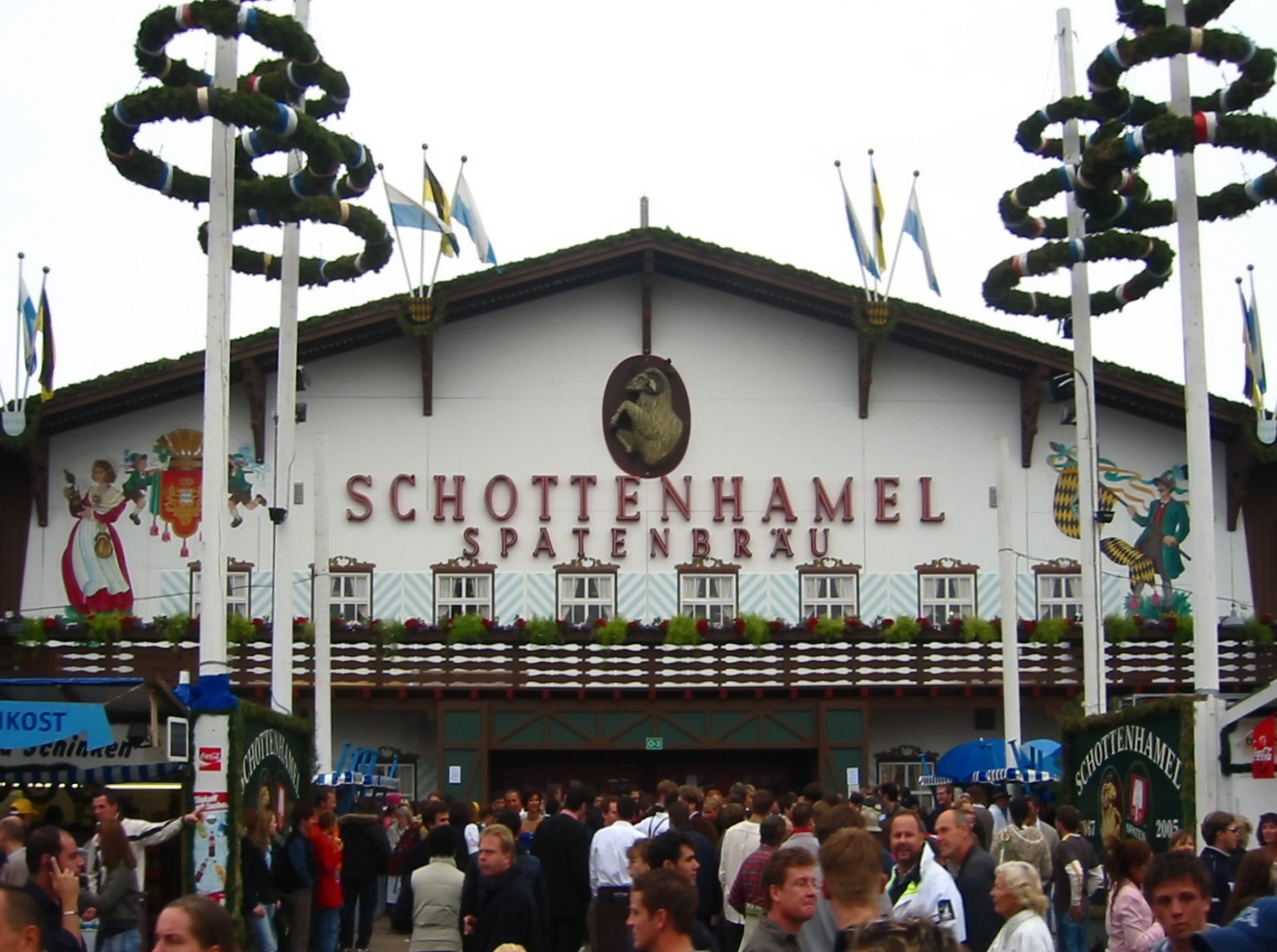
1. We are all animals. I realized this during my second day “on the Wiese” (as all the cool kids say it). We went early in the morning, even before most people were drunk, to meet some friends from other German cities and the Netherlands. Schottenhamel was our destination. We get there, and the line to get in is wrapped around the whole building. But, I can see friends Daniel and Alvaro a ways up in line. Because of what it takes to get into one of these Zelte, people who cut in line undoubtedly have a special ring in Hell reserved for them, so that was out of the question. I did want to go say “hello,” though, so up I went.

Daniel and Alvaro are grinning, and I go to shake their hands. “Hey, what’s going on, g-”

Someone on my right shoves me so that I bounce a few yards to my left. “Go!” yells a squat man, maybe 30 years old, with shoulders that touch his ears. “You can’t be here, get away from him!”

I’m standing next to a line in the middle of public, so I’m not out of bounds, or anything. He seems to be trying to prevent me from cutting in line. Maybe tons of people do that.

“Sorry, man. I was just saying hello to my-”

“Go, now!” Now, he’s approaching me. His nostrils are flared, and he’s wearing his brow like a welding visor.

Yikes, better leave. “See you guys inside,” I tell Daniel and Alvaro, and then I head back to the line where Roxana has our place.

At first, I thought that guy was just a rogue turd basket taking his bad day out on Oktoberfest attendees. I now think differently, because that kind of behavior is definitely a trend among the event’s security reps–pushing, moving in your way until you throw away your outside drink, dragging you down from a table and pushing you outside. It all seems pretty intense. But, I think they do it for a reason.

Oktoberfest is 17 days of insanity wrought by about 7 million attendees from all around the world. The normal population of Munich is about 4 million, and it would seem that a sizable chunk of the local population go on vacation during Oktoberfest. Many of those attendees are drunk the entire time. If I’m working security at an event like that, then I’ve probably seen things, man. Thing I dream about when it’s cold and rainy outside. And maybe part of me is terrified of doing this, again.

2. There’s an entire weekend (unofficially) devoted to Italy. It’s called “Italian Weekend.” During that weekend, Italy comes to Munich, and all the Germans I know stay home. That’s all I know about Italian Weekend.

3. Schottenhamel and Hippodrom are the “Zelt” names you should know. “Zelt,” according to Google Translate, is the German word for “Tent.” Google Translate is known to drink itself into an incomprehensible stupor when you ask it to reconcile German with English, though, so I’m not sure a German tent is the same thing as a rest-of-the-world tent. Two reasons I think this:

a) “Hey Googs, what up!? Have a question for you, man. My sister just had a baby, and I want to tell my German friends about it. What do I say?”

(Hiccup) “Hey, man! You’re the guy! Sure, I’d love to…um…help!” (hiccup) “Well, um…” (hiccup) “you might try ‘Meine Schwester hatte ein Kind.'” (hiccup)

I’m squinting, trying to figure out if I should trust him. “Um, okay Googs. I’ll see what happens.”

—1 day later—

“Thanks, jerk!” I say. “Do you know how sad everyone got when I told them what you told me to say?”

“Duuuuuuuhhhhhhhhhhh…”

The problem with what I said is that, in German, you say “Meine Schwester hat ein Kind bekommen,” not “Meine Schwester hatte ein Kind.” Google told me to say “My sister had a baby,” when Germans really say “My sister received a baby.” The natural question that follows my announcement is “Oh my God, what happened to it? Where’s the baby, now?”

So I never trust Google with my German questions.

b) A “Zelt” looks like this:

Image

Would you call that a “tent?”

Anyway, you should know what Schottenhamel and Hippodrom are before you go to Oktoberfest. Schottenhamel is the rowdy Zelt, while Hippodrom is the classy Zelt. Here, what “classy” means is that people are more or less in their seats the whole time, and fewer people are ever at risk of drunkenly stumbling off a balcony.

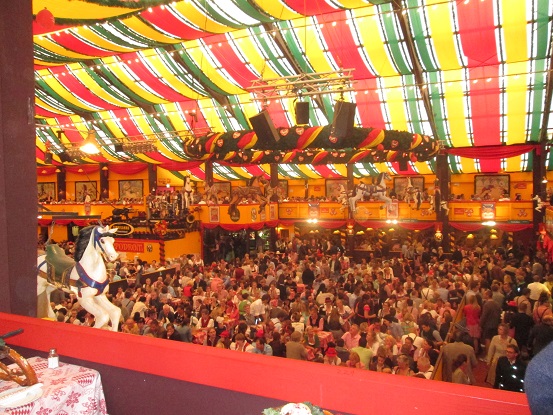
We went to Hippodrom with some friends who had reserved a table about a year ago. The tables are just big enough for 8 people to sit at them, the inside of the tent is filled with bright colors and statues, and the band is elevated above the ground floor on its own platform. Most of the people there seemed to be making the evening all about simply talking and drinking with their group of friends, and one of my German friends is of the opinion that that’s mostly how things go at Hippodrom. Here are some views of the inside from our table:

IMG_1304IMG_1309

Shottenhamel, on the other hand, is more of a party-with-randos tent. We were there for 3 hours in the morning (9am-noon), and it was definitely rowdier than Hippodrom. Maybe 20 minutes after we sat down on the second floor, a guy a few tables down climbed up onto the railing and lifted his glass, looking around. Instantly, everyone around us began cheering and chanting for him to drink his whole liter of beer without a pause. He started, and kept drinking as the cheering turned into an excited roar. Halfway through, two of those big security guys from before showed up and tried to drag him down from the railing. But, the guy wasn’t ready to leave. He finished chugging the beer while fighting off security with his free hand. Finally, he finished the beer, and the crowd roared approval while security dragged him down the steps and threw him out of the Zelt. This happened, plus or minus the security guys, about every 20 minutes. Here’s what the inside of Schottenhamel looks like (I didn’t bring the camera that day, so here’s something from Google images):

schottenhamel-2

4. You can only get into most “Zelte” with reservations–months to a year in advance. I don’t have much to say about this, except that we’re extremely lucky that our friends had space free at the table they reserved a year ago. This is just something you should know before you go–it’s never too early to try to get seats in a Zelt.

5. Oktoberfest is when Munich lets itself go absolutely nuts. A friend of mine was yelled at by his neighbor when he threw his garbage in the dumpster at 8am, because it made too much noise. Housework on Sunday is illegal for the same reason. Walk around the city during the week, and you see people passing the time simply by sitting and looking at one another. Or, they’re in a park, lying on the grass. And that’s it. If it’s the end of September, though, and you hear this song, then you’d better pick up your beer and jump up onto a table:

Wow, That Was Pretty Easy

Germany gave me a Visa, today. I haven’t reached my ultimate goal, yet, but this Visa is valid until April of 2014. So, this is definitely a valuable step en route to my ultimate goal.

It’s a Language Student Visa. Obviously, it allows me to stay here while I learn German and complete my metamorphosis into a pork-eating, beer-drinking, symmetry-loving, no-shoes-in-the-house deutschmann. If I’m admitted into LMU’s Master program, then I’ll be upgraded to a Student Visa and granted permission to stay here until October 2015. If we stay in Germany after that, I’ll use my new education and German fluency to find a job and obtain a Residence Permit for Work. For now, though, I have a Language Student Visa until April 2014. So let’s focus on that.

Shocking to me was how easy and fast it was to get this Visa. Well, it’s not necessarily easy to get a visa in Germany. What I can say more certainly is that it’s easy for a U.S. citizen to get a visa in Germany. The U.S. is a member of a group of countries whose citizens don’t need visas before entering Germany. We get 90 days for free, during which we can mess around with the visa requirements and apply while we’re here. I’m definitely going to come up with some theories about why these countries are on the list (unless I find an actual fact about it first), but not now. If you’re curious, here are the other countries:

  1. Andorra
  2. Australia
  3. Brazil
  4. El Salvador
  5. Honduras
  6. Israel
  7. Japan
  8. Canada
  9. Monaco
  10. New Zealand
  11. San Marino
  12. South Korea

Without knowing at all what I’m talking about, I’ll hypothesize that the motivations behind that list are talent attraction, humanitarianism (refuge), and political negotiation. Now, let’s hop off this tangent and get back to how getting this visa was easy. First, here’s a list of my requirements:

  1. Passport
  2. Passport photo
  3. Proof of German Health Insurance
  4. Proof of enrollment in a language school
  5. Proof that I won’t be broke before my visa expires

I started applying for this visa about two weeks ago, 70 days after I got here. Since I had 90 days to obtain a visa, that puts my procrastination factor at .78. I received my visa today, 94% of my way to the deadline, immediately after I submitted my application for it. So, why didn’t I receive the visa back at the 78% point? Two reasons:

  1. The “Student Application Visa” is a phantom tip
  2. Mother F#@$*& Heatlh Insurance

I asked for a Student Application Visa, hoping it would give me time to apply to LMU. After Desk Lady’s head exploded, she said that what is possible is a Language Student visa. All I need to do is get a note from the language school that confirms that I’m enrolled. Oh, okay.

Oh, and there’s a problem with my health insurance. I took out a policy with Techniker Krankenhaus–a popular public firm that caters to students and employed people. They arranged for my policy to activate when I begin the Master’s program. In October. “What will cover you between now and October?” asked Desk Lady.

“Dammit,” I replied.

So, I went home and learned a little about some of the private companies here who offer short-term policies. These are really just red-tape policies, right? I can manage safety for three months, I think. So, I don’t care what they offer, as long as Germany considers them legitimate and they are inexpensive. I “applied” with a company called…something to do with “care.” Don’t ask me.

Within hours of “applying,” I received my policy in pdf form. That was two days ago. And today I have a visa.