Everybody’s Hilarious in a Foreign Language Course

All of us, from everywhere, sound hilarious when we try to learn a foreign language. It would seem that we from the US, at our worst, are the most hilarious*, but I promise you can find something funny about the way everyone speaks.

What’s interesting, though, is how each of us sounds hilarious. Over the course of my 4 German courses to date, our teachers have corrected the way we speak about 1 million times each. Especially Valentin, though because he’s a boss. I really wish I could get a picture of Valentin looking especially teacherly (a bit hunched in his seat, hands clasped in front of his face, looking at a student sideways through squinted eyes, on the edge of his seat, waiting to see if the student’s answer is correct). But, I can’t take don’t-worry-about-me-bro-I’m-just-texting-someone photos with my dedicated digital camera.

Anyway, I’m noticing patterns among Valentin’s and other teachers’ corrections, specifically when it comes to pronunciation. Since Monday’s the greatest day of the week, here are some smile-worthy observations.

Different Nationalities and their Problems with German Pronunciation

  1. American: Yeah, I’ll do us, first. Our major problem (this one actually comes straight from Valentin) is how we pronounce “u” and “ü.” He rags on me for this maybe 100 million times per class, assuring me that “yes, you all [Americans] have problems with that.” “U” sounds like “oo” in America-speak, while we don’t have a “ü” sound. You have to move your bottom jaw forward, pull your tongue back and purse your lips when you say it. If mouths had professions, Germany’s would be a circus acrobat.
  2. Spanish/Latin American: They add syllables to the beginnings of words–especially the ones that begin with “S.” They also add a syllable before an “s,” when the “s” follows another hard consonant. “Strasse” becomes “eh-strasse,” for example.
  3. Italian: They add syllables to the ends of words that end in consonant sounds. “Mein,” becomes “Mein-eh,” for example. This one gets funny, because many German feminine words end in the “-eh” sound, so the teacher often corrects their grammar instead of their pronunciation. Then, the student corrects the teacher’s correction.
  4. Japanese: They just add syllables. A Japanese girl in my last class told me that it may be because Japanese words usually have the speaker bouncing from consonant to vowel very smoothly, while German tends to connect many syllables with back-to-back consonant sounds. Think of the name “Hideki.” Every vowel sound touches a consonant sound, and vice versa. Now, think of “Krankenwagen.” Going from “n” to “k,” and from “n” to “w,” might be uncomfortable for a Japanese native at first. They would say something close to “Kran-o-ken-o-wagen.” Of all the wrong ways to pronounce a language’s words, they definitely have the coolest.
  5. Slavic/Uralic Languages: So far, I’ve been classmates with Bulgarians, Russians, Ukrainians, Lithuanians, Croatians, Belorussians, and Hungarians, so they’re the groups from whom I’m getting this pattern. Especially in two-syllable nouns, they accent the second syllable, while Germans often accent the first one. Germans say “BAHN-hof,” while a member of this group really wants to say “bahn-HOF.” Valentin rags on these of my classmates for this almost as often as he rags on me for “ü.”

And there you have it–those are the patterns that have come to light so far. I find this kind of thing is hilariously interesting (a single activity from the points of view of different nationalities), so I had to write about it. I hope you find this either hilarious or interesting, too.

If not: ohgodforgivemeryan@gmail.com.

* I’ve had this “people speak funny” conversation in real life with people from other countries. In each one, they bring up how funny Americans usually sound when they try to speak another language. When they explain what they mean, they always imitate us with “r”-heavy sentences. Come to think of it, we do have an unusual “r.” Everyone else seems to have either silent Rs, or super-mouth-backflip-roll Rs. So maybe that’s why we sound so funny.

Deutsch Lernen: What You Can Do After 4 Months

Ja, ich Kann!
Graduating level A gives you an unparalleled sense of pride.

About a week ago, my class and I graduated from A-level German. We’ve just started B1, then. The way I see it, this is a good time to reflect on what A-level German lets a person do in Germany. Or, more practically speaking,  this is about what a person can do with German after 4 months of studying it in its native environment. Awwwww yeah.

First, let’s refresh over the European language system–all of that A/B/C stuff. The system is divided into three levels–A, B and C–which are themselves each divided into two sub-levels. You start in A, and you progress through C. You need to finish B before you look for a job that requires skill in German to perform–most jobs that don’t belong to Texas Instruments, Amazon, Intel, Microsoft and the like. C, I’ve been told, is meant to give students an academic grasp of German. My teachers have told me that C1 could be beneficial to those who want to be sophisticated, but C2 is almost completely pointless.

So, now I’m at the beginning of B1–the beginning of the level that transforms people from residents into professionals.

Come to think of it, “resident” is a really good word for describing what level A (4 months of training) has done for me. After 4 months, I can speak German at people, rather than with them. I can listen to simple requests and advice and respond in either really simple or really broken manners. For example, I can do these things:

  • Order at a restaurant
  • Pay for things
  • Ask for directions to places
  • Introduce myself
  • Tell people why I’m here (see my first post)
  • Look for a job (but not interview for one)
  • Discuss politics just a little bit (who’s running, party platforms, tell someone I can’t vote because I’m not a citizen)
  • Navigate public transportation (which train? when does it get here? oh God, it’s late? do I need to transfer? are there taxis?)
  • Tell people what I do for a living
  • Tell people about my plans to go back to school
  • Ask what a word means
  • Request that the speaker slow down or simplify their words

I can maybe do some other things as well, but those are the things that I have to do a lot.

Also, it’s good to keep in mind I can’t exactly call the contexts in which I employ those abilities “conversations.” Rather, it’s an exchange of simple sentences that both of us understand. I don’t call them “conversations,” because at least one of us is always thinking “that’s probably not exactly what they mean, but it’s close enough to inform my next action.”

A is designed to bring a person to functioning order within German society, then. It serves to ward off foreigner-terror (that’s terror of being a foreigner, not a terror of foreigners) and help one convey that they’re trying to learn the language.

I expect B to make me a conversationalist. I’ve looked ahead in the lessons, and I’m seeing crucial pieces to the conversation puzzle that were missing in A. Namely, I’m seeing complex sentences–main clause plus subordinate clause. Command of subordinate clauses is a huge difference between a speaker who appears “conversational,” and one who does not. With that ability, I can vary up my sentence structures, which will make me look confident.

Oh boy, is that going to be fun.

Post #5 – Two More Classmates, Hideki Still on his Own

Right now I would be writing about how many native Spanish speakers live in Munich, but something important developed in my German class, today. So, I’m going to save my excitement over the extra utility of my childhood Spanish classes for another day.

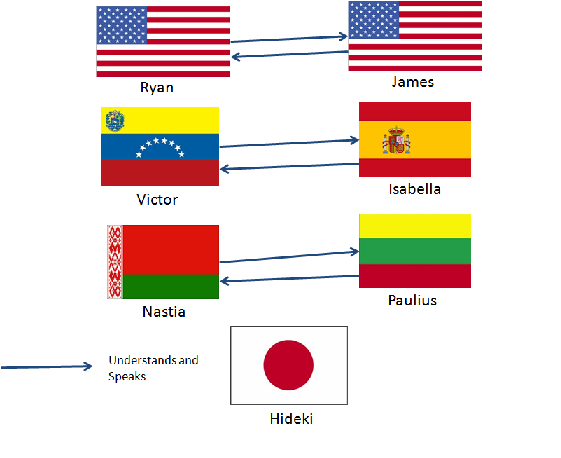
Two new people joined our class. I’ll call them James and Nastia. James is from the US (Los Angeles) and only speaks English. Nastia is from Belarus and only speaks Russian.

Hideki is still from Japan and only speaks Japanese.

These additions are interesting because they add balance to our roster that could be either amazing or terrible. You may have read my second post and remember that our class communicate kind of like this:

Image

Isabella, Victor, Paulius and I make do with our various language skills and communicate with words, while Hideki is a complete boss and manages to fit in without using words (or understanding them). Seriously, that guy rules. What will happen now that our two new classmates have joined us, though? My hope is that we have more perspective. We can all compare California with Texas, and figure out how diverse the US is. We can also compare Lithuania with Belarus and learn what the two countries share besides Russian. All the while, Paulius is translating to and from Russian, and I’m translating to and from Spanish. Even typing that sentence made me want to do jumping jacks.

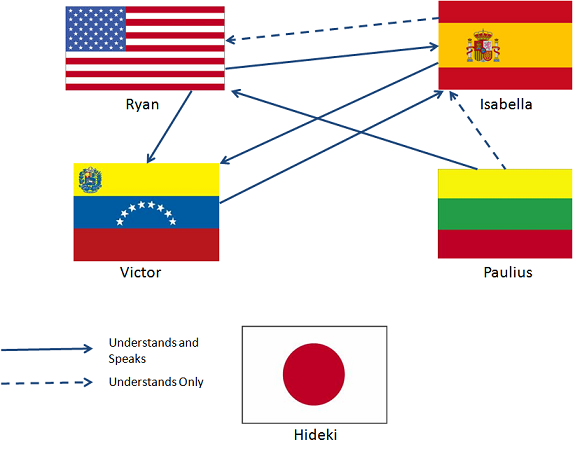
Isabella and Victor give us hope. From the two of them, we’ve been learning how Venezuela differs from Spain (including how Spanish differs between the two countries). What I’m worried about though, is how foreboding our class’s newfound balance is. Behold…

Image

With the addition of these two new classmates comes the creation of comfort zones. One zone speaks English, another Russian, and a third Spanish.  James and I get to practice our English, Isabella and Victor get to practice their Spanish, Nastia and Paulius get to practice their Russian, and Hideki takes residences in zone #4–the ultimate discomfort zone.

Hopefully that’s not how things work for us. Hopefully the addition of two new classmates comes with the addition of two new perspectives and languages we can all share. Hopefully we can keep getting drinks and playing nonverbal guessing games with Hideki the Boss.

Also, I’m not sure where to write this, since I don’t foresee a whole post dedicated to it, so I’ll mention it here. We were talking about sports we like to play the other day, and when I said “Ultimate Frisbee” the entire class died laughing. Welcome to Europe, American.

Post #3: A Post about Hideki

This post is going to refer to my classmates a bunch of times. If you missed my first post about them, scan it to learn whom each person is.

Hideki is the Japanese guy in my German class. As I mentioned in my post yesterday, he only speaks Japanese. So, as hard as it may sound to learn German from scratch as a westerner, this guy is having a Hell of a time. Luckily, he has a pocket PC and some translation software with him.

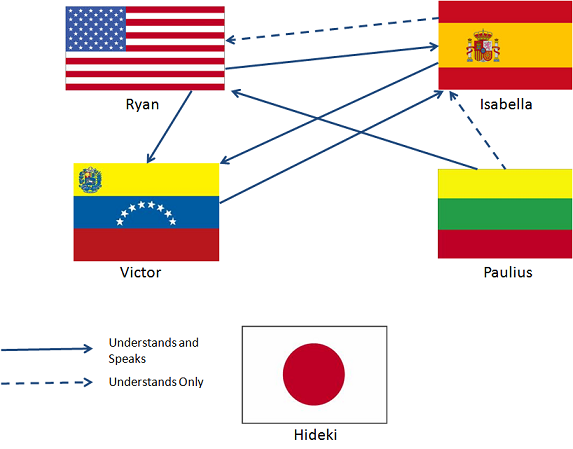
Anyway, his coping methods aren’t what’s important right now. What’s important is what his…linguistic situation…means for our relationships as classmates. It means that Hideki is always somehow a part of our conversations, but we have no idea how much a part of them he is. Here’s a diagram that shows how we communicate with native languages (now, at least, since our German is pitiful):

Image

Here’s an example. Are we on the same page as Hideki, or not?

Ryan: Hideki! ‘Wie’ und ‘was?’ (Shrugs and shakes head because we haven’t learned “What’s the difference?”  or “We’re confused. Do you know?” yet)

Hideki: HAHAHAHAHAHA! (while shaking head)

Either he knows what our problem is and he’s saying it’s his problem, too, or he’s telling me “sorry, I don’t know what you’re trying to say.”

We all shared a similar exchange on Monday, when we introduced ourselves and talked about where we were before Germany. He kept saying “near Osaka,” and our teacher kept asking “Yeah, but from where” (“Ja, und wie heiβt?”). And he kept saying “Osaka.”

That was also before we all knew much German at all. We tried playing charades to no avail. Hideki remained a mystery.

But today: Hideki, unveiled! Sort of. Now, we’re all experts at saying where we’re from, what our hobbies are, where we live, what we do for a living, which languages we know, and some other stuff. So, today, we all went through the small talk dance, again (we had teacher #2 today, and he hadn’t heard our small talk, yet). Woher kommst du? Wo wohnst du? Hast du hobbys? Was bist du von Beruf? (“What do you do for work?”) Was ist dein hobby? Wo ist deine heimatstadt? Hat deine Heimatstadt gutes Bier? Those last two are “Where is your hometown?” and “Does your hometown have good beer?” To these, Hideki answered like this:

Heimatstadt: in Mie, Japan

Hobby: Schwimmen

Gut Bier: Nein

Beruf: Wirtschaft student

His hometown is somewhere in Mie (clearer than “near Osaka!”), he swims for his hobby, his hometown doesn’t have good beer, and he’s an economics student! Great to meet you, Hideki!

I’m especially excited after today’s conversation. We’re all shaky at communication right now, as the diagram earlier in this post points out. However, as we progress in this class, we’re all going to share German, which is nobody’s native tongue. That means when we get together, the easiest way to communicate will be abandoning our native languages in favor of this one we just learned, here. That’s fun.

Post #2: German for Non-Germans

I remember learning Spanish and Chinese in American classes. The teacher would explain one of the language’s concepts in English, then define each vocabulary word in English. Finally, we would practice in the new language. I grew accustomed to that method. It became the easy way to learn.

Now, I’m in a German class full of people who don’t speak English at all. Well, that’s not entirely true. One guy kind of speaks English. And the people teaching the class know how to speak English. They can’t, though. It would go right over most of the class’s head. While we’re on the subject, these are my classmates:

  1. Isabella: Spanish girl who only speaks Spanish.
  2. Victor: Venezuelan guy who only speaks Spanish.
  3. Hideki: Japanese guy who only speaks Japanese.
  4. Paulius: Lithuanian guy who speaks Lithuanian and some English.
  5. Eva: German girl who is the class’s teaching assistant and speaks German and a little English and Spanish.

I’m changing each classmate’s name for this blog. Most of me thinks it would be no big deal to use their real names, but the paranoid part (read: considerate part?) of me thinks I should ask them if it’s okay before doing so. And I’m not ready for that conversation, yet. Hey, nice to meet you. I’m gonna blog about you. Can I use your real name?

Anyway, these teachers’ (there are two who alternate) approaches are different than the ones my American teachers used. The entire class is in German, so they speak in patterns until we’re able to infer the meaning of a word or phrase. For example:

“Ryan kommt aus den USA. Paulius kommt aus Litauen. Ich komme aus Deutschland. Woher kommst du, Isabella?”

At this point, we all infer that he’s talking about where we’re from, and Isabella just heard how to say it in the first person, so she can answer “Ich komme aus Spanien.” We all have an inkling that “ich” is “I,” “kommt” “kommst” and “komme” are all conjugations of some verb that means “to come” and when you want to say you’re from a place, you say “aus [the place].” It’s only been three days, but I’m thinking this is a really effective way to learn. My head hurts after three hours in a way that says that has to be the case. Anyway, it makes us think a bit harder about the language, and it forces us to bypass the awkward translation stage of learning a language (think in English, translate to German, speak in German).

So there’s a really good reason to study a language in its home country. Another one is that it’s crazy learning a language with people who speak different languages natively. You get to see, for example, which phonetics give Spaniards a tough time, and which structures give Japanese people a tough time (it would seem that all of them do in a Western language like German). Look forward to more about that in a future post.

Also, in the near future, I’ll write about my classmates’ reasons for being in Munich, InterNations–a networking group for expats (we’re going to some kind of night club party on Thursday with them)–trying to eat with a growing German vocabulary, and maybe the time I got sick after eating German quesadillas (yeah, I should have known better).

Tschüss!