What if We Stopped Learning to Speak Other Languages?

second-languageWhen’s the last time you learned a second language? What was learning it like?

I’ve been learning second languages for awhile, now. I made it through the German classroom circuit about a year ago, and now I’m in my streets phase with the language. In college, I studied Mandarin. As a child and then again in Junior High and High School, I learned Spanish. Sure, every language has its weird/unique mind games it can play with non-natives: German breaks more rules than it even has, learning to speak and write Mandarin basically means learning two languages at once, and Spanish has as many verb tenses as it has polite expressions that mean something dirty if you wink while you say them (lots and lots).

Despite the idiosyncrasies, learning a language is always the same in at least one respect: you can understand it before you can speak it.

And what was it like when you started using that shiny new second language you studied? Or, what’s it like using it now that it’s worn, flexible and maybe a little dirty? Have you ever wished you could simply communicate in your native tongue for just one second because you knew you’d be funnier, smarter, friendlier, more eloquent if doing so were appropriate?

Those two ideas have been stuck in my head for a good while, and they’re really making me wonder if life would improve if we all stopped learning to speak second languages. I know, I know, there’s at least one huge problem with that. I’ll get to it in a bit.

For now, imagine what it would be like if you only had to learn to understand other languages. For one, it would be much easier to integrate one’s self into a foreign society. When it comes to understanding, you’re usually ready to go after a few months in a local language class. If teachers could remove all of the speaking exercises from class, fluency in understanding would come even quicker. Perhaps this would make learning more than one second language more common (among those who aren’t officially language students or don’t speak a Latinate language natively).

An implication of this is that learning a language could be an exercise in adaptation rather than preparation. We could wait until it looks like needing the language is likely before we commit to learning it. Contrast that with the current approach: we spend years before and during college learning a language that might never be relevant during our particular lives. I, for example, studied Spanish as a child, because Mexico and Texas are sharing each other’s cultures more and more every year. As it turns out, Spanish has become very useful to me during my particular life. My girlfriend is Mexican, after all.

And now we live in Germany. Predictable needs for language skills, right?

Another aspect of life made better is maintaining proficiency in a language when you’re not using it. Lack of practice has to be the most common reason people are weak in a second language, even though they’ve studied it. My Mandarin was great when I was in college. Now, I sound like I’m trying to teach myself quantum physics, and that’s because I’ve been in precisely 0 situations that demanded my control of Mandarin since then.

To practice speaking, you need a speaking partner. Until you move to the country that speaks your second language natively, finding a speaking partner is tough. Practicing listening, though? Honing your ability to understand the language? That’s a piece of cake, no matter where you are. Subscribe to a podcast, tell YouTube you live in the language’s home country, watch movies in that language, find music on Spotify, Google online news media in the language, download a language pack for that video game you play once a day, change the OS language on your PC. Options for improving understanding are all over the place.

So, what would a bilingual conversation feel like? I think it feels really cool. Roxana and I have them every now and then. The results are maximum clarity and almost maximum comfort for both parties–Rox freaks out a little bit after a few minutes of conversation 🙂 Incidentally, this is also how almost the entire television show “Lillyhammer” works–the main character speaks English, while every other character speaks Norwegian. Bilingual conversations look cool, as well.

I’ve tried the approach with some German friends (without them knowing this is what I was doing). For about a minute, we’re having an especially cool conversation. They’re speaking German, while I’m speaking English. My mind feels fresh and energetic. I’m relaxed, as I assume are they. After the minute, though, my German friend will usually switch to English, presumably because they think I prefer English and they want to be nice. Then, I feel lazy and switch to German, and by the end of the conversation, I’m tired. It’s ultimately a really good mental exercise, but I’ve learned without a doubt that speaking is more mentally taxing than is understanding.

Despite its coolness, this supposed solution does not solve an existing problem. We could call it the Lingua Franca problem.
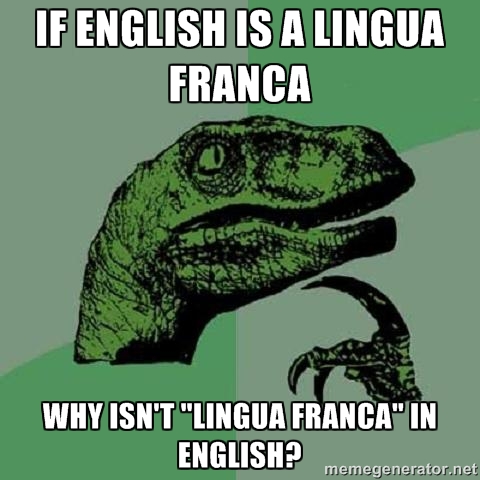
Philosoraptor - Lingua FrancaToday, the western world’s Lingua Franca is English–it’s the bridge language that most commonly connects people who don’t speak each other’s native language. If the bridge doesn’t connect both sides of the conversation, however, communication is not possible. That’s not necessarily praise or criticism. Just reality.

The “understanding only” system I describe in this post doesn’t fix this problem. At best, a conversation in the “understanding only” system would be one-sided if the language I speak doesn’t appear on the list of languages you understand. Communication between us would not be effective, unless you were my boss and our company ran on peon blood.

In fact, there could be no Lingua Franca in the “understanding only” system. We’d all be proficient speakers in only one language. If everyone on earth learned to understand English, that would mean nothing if the English-speaking world refused to learn to understand other languages. Or, what if English speakers tended to learn other languages, but not my language? That would suck–I would need to learn to speak English, even though speakers of other languages could get by with their comfortable native tongue.

And UN meetings would probably be complete messes.

But, every solution to international communication so far has its problems. It’s hard to motivate the world to learn and practice Esperanto. And, when an existing world language is the Lingua Franca (the current system), that arguably gives countries where the language is native an upper hand on the world stage.

Thought experiments are fun, aren’t they?

Everybody’s Hilarious in a Foreign Language Course

All of us, from everywhere, sound hilarious when we try to learn a foreign language. It would seem that we from the US, at our worst, are the most hilarious*, but I promise you can find something funny about the way everyone speaks.

What’s interesting, though, is how each of us sounds hilarious. Over the course of my 4 German courses to date, our teachers have corrected the way we speak about 1 million times each. Especially Valentin, though because he’s a boss. I really wish I could get a picture of Valentin looking especially teacherly (a bit hunched in his seat, hands clasped in front of his face, looking at a student sideways through squinted eyes, on the edge of his seat, waiting to see if the student’s answer is correct). But, I can’t take don’t-worry-about-me-bro-I’m-just-texting-someone photos with my dedicated digital camera.

Anyway, I’m noticing patterns among Valentin’s and other teachers’ corrections, specifically when it comes to pronunciation. Since Monday’s the greatest day of the week, here are some smile-worthy observations.

Different Nationalities and their Problems with German Pronunciation

  1. American: Yeah, I’ll do us, first. Our major problem (this one actually comes straight from Valentin) is how we pronounce “u” and “ü.” He rags on me for this maybe 100 million times per class, assuring me that “yes, you all [Americans] have problems with that.” “U” sounds like “oo” in America-speak, while we don’t have a “ü” sound. You have to move your bottom jaw forward, pull your tongue back and purse your lips when you say it. If mouths had professions, Germany’s would be a circus acrobat.
  2. Spanish/Latin American: They add syllables to the beginnings of words–especially the ones that begin with “S.” They also add a syllable before an “s,” when the “s” follows another hard consonant. “Strasse” becomes “eh-strasse,” for example.
  3. Italian: They add syllables to the ends of words that end in consonant sounds. “Mein,” becomes “Mein-eh,” for example. This one gets funny, because many German feminine words end in the “-eh” sound, so the teacher often corrects their grammar instead of their pronunciation. Then, the student corrects the teacher’s correction.
  4. Japanese: They just add syllables. A Japanese girl in my last class told me that it may be because Japanese words usually have the speaker bouncing from consonant to vowel very smoothly, while German tends to connect many syllables with back-to-back consonant sounds. Think of the name “Hideki.” Every vowel sound touches a consonant sound, and vice versa. Now, think of “Krankenwagen.” Going from “n” to “k,” and from “n” to “w,” might be uncomfortable for a Japanese native at first. They would say something close to “Kran-o-ken-o-wagen.” Of all the wrong ways to pronounce a language’s words, they definitely have the coolest.
  5. Slavic/Uralic Languages: So far, I’ve been classmates with Bulgarians, Russians, Ukrainians, Lithuanians, Croatians, Belorussians, and Hungarians, so they’re the groups from whom I’m getting this pattern. Especially in two-syllable nouns, they accent the second syllable, while Germans often accent the first one. Germans say “BAHN-hof,” while a member of this group really wants to say “bahn-HOF.” Valentin rags on these of my classmates for this almost as often as he rags on me for “ü.”

And there you have it–those are the patterns that have come to light so far. I find this kind of thing is hilariously interesting (a single activity from the points of view of different nationalities), so I had to write about it. I hope you find this either hilarious or interesting, too.

If not: ohgodforgivemeryan@gmail.com.

* I’ve had this “people speak funny” conversation in real life with people from other countries. In each one, they bring up how funny Americans usually sound when they try to speak another language. When they explain what they mean, they always imitate us with “r”-heavy sentences. Come to think of it, we do have an unusual “r.” Everyone else seems to have either silent Rs, or super-mouth-backflip-roll Rs. So maybe that’s why we sound so funny.

Deutsch Lernen: What You Can Do After 4 Months

Ja, ich Kann!
Graduating level A gives you an unparalleled sense of pride.

About a week ago, my class and I graduated from A-level German. We’ve just started B1, then. The way I see it, this is a good time to reflect on what A-level German lets a person do in Germany. Or, more practically speaking,  this is about what a person can do with German after 4 months of studying it in its native environment. Awwwww yeah.

First, let’s refresh over the European language system–all of that A/B/C stuff. The system is divided into three levels–A, B and C–which are themselves each divided into two sub-levels. You start in A, and you progress through C. You need to finish B before you look for a job that requires skill in German to perform–most jobs that don’t belong to Texas Instruments, Amazon, Intel, Microsoft and the like. C, I’ve been told, is meant to give students an academic grasp of German. My teachers have told me that C1 could be beneficial to those who want to be sophisticated, but C2 is almost completely pointless.

So, now I’m at the beginning of B1–the beginning of the level that transforms people from residents into professionals.

Come to think of it, “resident” is a really good word for describing what level A (4 months of training) has done for me. After 4 months, I can speak German at people, rather than with them. I can listen to simple requests and advice and respond in either really simple or really broken manners. For example, I can do these things:

  • Order at a restaurant
  • Pay for things
  • Ask for directions to places
  • Introduce myself
  • Tell people why I’m here (see my first post)
  • Look for a job (but not interview for one)
  • Discuss politics just a little bit (who’s running, party platforms, tell someone I can’t vote because I’m not a citizen)
  • Navigate public transportation (which train? when does it get here? oh God, it’s late? do I need to transfer? are there taxis?)
  • Tell people what I do for a living
  • Tell people about my plans to go back to school
  • Ask what a word means
  • Request that the speaker slow down or simplify their words

I can maybe do some other things as well, but those are the things that I have to do a lot.

Also, it’s good to keep in mind I can’t exactly call the contexts in which I employ those abilities “conversations.” Rather, it’s an exchange of simple sentences that both of us understand. I don’t call them “conversations,” because at least one of us is always thinking “that’s probably not exactly what they mean, but it’s close enough to inform my next action.”

A is designed to bring a person to functioning order within German society, then. It serves to ward off foreigner-terror (that’s terror of being a foreigner, not a terror of foreigners) and help one convey that they’re trying to learn the language.

I expect B to make me a conversationalist. I’ve looked ahead in the lessons, and I’m seeing crucial pieces to the conversation puzzle that were missing in A. Namely, I’m seeing complex sentences–main clause plus subordinate clause. Command of subordinate clauses is a huge difference between a speaker who appears “conversational,” and one who does not. With that ability, I can vary up my sentence structures, which will make me look confident.

Oh boy, is that going to be fun.