Post #3: A Post about Hideki

This post is going to refer to my classmates a bunch of times. If you missed my first post about them, scan it to learn whom each person is.

Hideki is the Japanese guy in my German class. As I mentioned in my post yesterday, he only speaks Japanese. So, as hard as it may sound to learn German from scratch as a westerner, this guy is having a Hell of a time. Luckily, he has a pocket PC and some translation software with him.

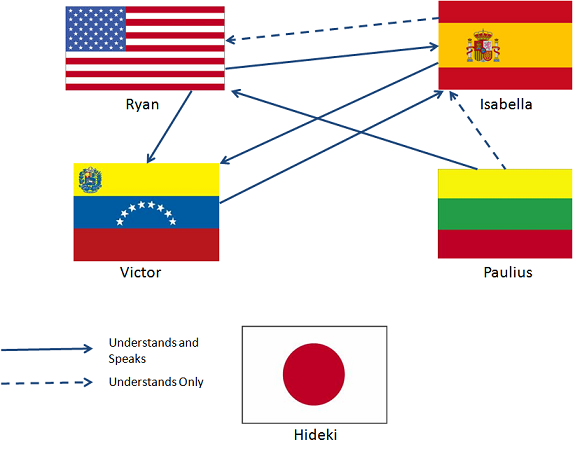
Anyway, his coping methods aren’t what’s important right now. What’s important is what his…linguistic situation…means for our relationships as classmates. It means that Hideki is always somehow a part of our conversations, but we have no idea how much a part of them he is. Here’s a diagram that shows how we communicate with native languages (now, at least, since our German is pitiful):
Image

Here’s an example. Are we on the same page as Hideki, or not?

Ryan: Hideki! ‘Wie’ und ‘was?’ (Shrugs and shakes head because we haven’t learned “What’s the difference?”  or “We’re confused. Do you know?” yet)

Hideki: HAHAHAHAHAHA! (while shaking head)

Either he knows what our problem is and he’s saying it’s his problem, too, or he’s telling me “sorry, I don’t know what you’re trying to say.”

We all shared a similar exchange on Monday, when we introduced ourselves and talked about where we were before Germany. He kept saying “near Osaka,” and our teacher kept asking “Yeah, but from where” (“Ja, und wie heiβt?”). And he kept saying “Osaka.”

That was also before we all knew much German at all. We tried playing charades to no avail. Hideki remained a mystery.

But today: Hideki, unveiled! Sort of. Now, we’re all experts at saying where we’re from, what our hobbies are, where we live, what we do for a living, which languages we know, and some other stuff. So, today, we all went through the small talk dance, again (we had teacher #2 today, and he hadn’t heard our small talk, yet). Woher kommst du? Wo wohnst du? Hast du hobbys? Was bist du von Beruf? (“What do you do for work?”) Was ist dein hobby? Wo ist deine heimatstadt? Hat deine Heimatstadt gutes Bier? Those last two are “Where is your hometown?” and “Does your hometown have good beer?” To these, Hideki answered like this:

Heimatstadt: in Mie, Japan

Hobby: Schwimmen

Gut Bier: Nein

Beruf: Wirtschaft student

His hometown is somewhere in Mie (clearer than “near Osaka!”), he swims for his hobby, his hometown doesn’t have good beer, and he’s an economics student! Great to meet you, Hideki!

I’m especially excited after today’s conversation. We’re all shaky at communication right now, as the diagram earlier in this post points out. However, as we progress in this class, we’re all going to share German, which is nobody’s native tongue. That means when we get together, the easiest way to communicate will be abandoning our native languages in favor of this one we just learned, here. That’s fun.

Post #2: German for Non-Germans

I remember learning Spanish and Chinese in American classes. The teacher would explain one of the language’s concepts in English, then define each vocabulary word in English. Finally, we would practice in the new language. I grew accustomed to that method. It became the easy way to learn.

Now, I’m in a German class full of people who don’t speak English at all. Well, that’s not entirely true. One guy kind of speaks English. And the people teaching the class know how to speak English. They can’t, though. It would go right over most of the class’s head. While we’re on the subject, these are my classmates:

  1. Isabella: Spanish girl who only speaks Spanish.
  2. Victor: Venezuelan guy who only speaks Spanish.
  3. Hideki: Japanese guy who only speaks Japanese.
  4. Paulius: Lithuanian guy who speaks Lithuanian and some English.
  5. Eva: German girl who is the class’s teaching assistant and speaks German and a little English and Spanish.

I’m changing each classmate’s name for this blog. Most of me thinks it would be no big deal to use their real names, but the paranoid part (read: considerate part?) of me thinks I should ask them if it’s okay before doing so. And I’m not ready for that conversation, yet. Hey, nice to meet you. I’m gonna blog about you. Can I use your real name?

Anyway, these teachers’ (there are two who alternate) approaches are different than the ones my American teachers used. The entire class is in German, so they speak in patterns until we’re able to infer the meaning of a word or phrase. For example:

“Ryan kommt aus den USA. Paulius kommt aus Litauen. Ich komme aus Deutschland. Woher kommst du, Isabella?”

At this point, we all infer that he’s talking about where we’re from, and Isabella just heard how to say it in the first person, so she can answer “Ich komme aus Spanien.” We all have an inkling that “ich” is “I,” “kommt” “kommst” and “komme” are all conjugations of some verb that means “to come” and when you want to say you’re from a place, you say “aus [the place].” It’s only been three days, but I’m thinking this is a really effective way to learn. My head hurts after three hours in a way that says that has to be the case. Anyway, it makes us think a bit harder about the language, and it forces us to bypass the awkward translation stage of learning a language (think in English, translate to German, speak in German).

So there’s a really good reason to study a language in its home country. Another one is that it’s crazy learning a language with people who speak different languages natively. You get to see, for example, which phonetics give Spaniards a tough time, and which structures give Japanese people a tough time (it would seem that all of them do in a Western language like German). Look forward to more about that in a future post.

Also, in the near future, I’ll write about my classmates’ reasons for being in Munich, InterNations–a networking group for expats (we’re going to some kind of night club party on Thursday with them)–trying to eat with a growing German vocabulary, and maybe the time I got sick after eating German quesadillas (yeah, I should have known better).

Tschüss!

Post #1: Setting the Stage

Today, I landed in Munich, Germany. Yesterday, I said goodbye to my friends and family. Two days ago, I sold my car. Two weeks ago, I left my job, sold everything in my apartment, and said goodbye to Dallas, Texas. Two months ago, I gave my supervisor my “notice of intent to self-terminate” (or whatever). And 4 months ago, I began falling in love.

I’ve been told a million times something like “life is full of unexpected adventures,” and I’m pretty sure I’m not exaggerating that. It sounds like a cliché that people vomit up when life starts to feel boring. But, I guess there’s still something about the idea that makes jaded sighs feel like one-time things.

I think I know what that sentence is talking about when people regurgitate it, but I don’t think I agree with its definition of “adventure.” By its definition, a month in Hong Kong, deciding to study Mandarin in college, “cabrewing” the entire length of the town creek (yeah, that’s just drinking beer in a canoe), sleeping under only a blanket in the woods on a fishing trip, and playing with explosives as a kid would be considered adventures, since they’re arguably broad strides away from familiarity. But for me, those activities have intellectual bases only. Let’s see if I can do this. Let’s see what happens when we do that. So, I don’t consider them adventures. Or if I do, then the “unexpected adventures” line is pretty much meaningless. Of course life is full of those kinds of things.

To me, real adventures are sparked and spurred by emotion, where the intellect is just invited along for the ride. During a real adventure, two forces oppose one another at all times: a compulsion to continue, and a compulsion to call it quits. Which compulsion wins and why are the reasons the intellect gets an invitation (analyzing that part would probably teach us something really interesting about ourselves). However, what makes adventure so tempting and so sexy are what happens during the battle between those compulsions–compulsions fueled by emotions like these:

  1. Hope
  2. Love
  3. Fear
  4. Alienation
  5. Curiosity
  6. Desire
  7. Ambition
  8. Devotion
  9. Discomfort
  10. Impatience
  11. Sadness
  12. Disappointment
  13. Boredom

And each of those can fuel either compulsion.

I’m on an adventure, now–been on it since December 2012–and this stage of it has me landing in Munich thanks to a one-way plane ticket from Texas. The blog you’re reading is about this adventure. Some of it will be about the girl. Some of it will be about the city. Some of it will be about being an American in Europe. Some of it will be about being an American metal fan in Europe. All of it will be about things working either for or against me. Things like:

  • I don’t speak German (yet).
  • I don’t have a job.
  • I don’t have a car.
  • I don’t have a phone.
  • I do speak English (hope that’s obvious).
  • I do speak Spanish.
  • I do have mad marketing skills (my professional background).
  • I do have love, and not the long-distance kind.

Keep reading, and live this thing vicariously. I’ll be thrilled and nervous, bold and terrified, jubilant and…er…bummed out. You can read and see what that’s like.