The KVR: Journey’s End

This morning was, as far as I can tell, the final hour I will need to spend in the Kreisverwaltungsreferat (the KVR) for a long time. As I mentioned yesterday, I had to return in order to correct an error on my visa extension. Namely, the expiration date was three months too early.

I blamed Cashier Lady, since she was responsible for taking my money and passing the print order through to Window Guy. I supposed it could have been Window Guy’s bad as well, but I was looking at the process from the outside. From there, Window Guy might as well be Cashier Lady. Naturally, then, I started this morning with Cashier Lady.

*****

“Good morning!” Admittedly, I’m projecting more patience than I actually possess. I’m missing another German class for this.

“Good morning.” Cashier Lady slides her fingertips under the glass that separates us. There’s not a chance she wants or expects anything other than documents.

“I was here yesterday,” I begin. Disappointment floods her eyes while her fingertips remain out of reach of my precious, precious documents. I press on, though. Get it all out before she dismisses you out of habit. “-and received and extension for my Visa. But, there’s a small problem with the new pass. The letter the office gave me says I have six months to confirm university enrollment. The pass, however, says that I only have 3 months.”

“You have to go to the student area.” She’s pointing at the heading on the letter I handed her.

Invalid command.

“Well, the student office gave me the correct letter. The problem is that I received the incorrect pass down here, yesterday.”

“There’s nothing I can do for you, here. You need to go back upstairs.”

Oh, no. Not back upstairs. Anywhere but back upstairs. Upstairs is where I spent 2.5 hours of my day, yesterday. Upstairs is where Desk Lady lives. Don’t make me go back upstairs.

“Ok. Thank you for your help.” For some reason, you always have to say that in these situations.

I’m going upstairs.

Remarkably, there are only 4 people on line upstairs. It’s a full hour after the KVR opened. Fearing that mentally questioning it will make it go away, I slide into line as fast as I can before I wake up and I’m behind 100 more people. I survey the staff behind the desk. There’s a new Desk Lady. And, Office Lady is standing next to her! Ha! Maybe she’ll remember me and will wonder why I’m here and then we’ll all share a hilarious laugh while she corrects the mistake on the spot. How fun that will be.

The four people in front of me are having problems, getting pwned like proper noobs. I can’t watch.

Soon enough, it’s my turn. “Good morning!” I smile.

“Good morning.” Desk Lady’s not unhappy, but she’s not smiling. Smiling is for Office Lady.

I tell her the exact same story I told Cashier Lady.

“Is the problem with your Passport? When does it expire?”

“2019. I have plenty of time before that one goes bad.”

I hand her my documents. She looks them over for a few seconds, and finally hands them to Office Lady.

Now, Office Lady’s talking. “Ah, yes there is actually a problem. Please find a seat, and I’ll call you in a minute.” A KVR experience without a waiting room is a pizza without cheese.

A few minutes go by. The waiting room is outrageously full. I’m pretty sure Office Lady runs the bottleneck of this operation.

And she’s back, smiling like it was yesterday. “I’ve arranged to have your pass fixed, now. You can just take this paper downstairs and the cashier will print you a new one. Of course, you don’t have to pay anything more.”

I’m smiling again. “Thank you very much for your help. Have a great day.”

“Likewise.”

On my way downstairs, I’m feeling really curious about the new paper Office Lady just handed me. It’s just like the one I handed Cashier Lady yesterday, except that it says “0.00 Euros” on it. It’s extremely light on text, but it does sport a reference number and a fancy bar code right below the heading. Suddenly, it dawns on me: Cashier Lady turning me down without explanation, Cashier Lady sending me back to Desk Lady, Office Lady doing all the thinking, my text-light message for Cashier Lady, and its bar code and reference number. Cashier Lady didn’t make the mistake, yesterday. It must have been Office Lady!

Office Lady! We had such a good thing, together. She smiled. She helped. She thought independently and needed no codified commands in order to do her job. She messed up.

That bar code must be a reference to information in a database–information that Office Lady inputs when she asks you to wait 40 minutes in the hallway. Cashier Lady must pass the sheet of paper to Window Man, who then simply scans the bar code. Doing that must initiate an automated printout of the document authorized by Office Lady. Office Lady!

Maybe, with “6 months” on the mind, she entered “Month: 6” into her system. Maybe the “9” in her head for “September” flipped itself without telling her, causing her to input the dastardly “6” instead. Maybe she liked my shoes and wanted to see them again.

I suppose there are a number of things that could have inspired the mistake. Maybe they’ll find a cure for humanity, one day. In any case, as I remember the past 3 weeks and reflect on the KVR Process–emotional computers, endless wait times, invalid commands and human errors–I can’t help but continue to think of Office Lady fondly. I think that, in a world of processing and checklists and appointments and eligibility requirements, what matters more than anything is personality. I’ll take the warm, helpful representative over the 100% effective one any day.

Not that I have any choice in the matter.
How I Got My Visa Extended

It’s 7:20 in the morning. As I leave the U-Bahn station at Poccistrasse, I see a crowd of other sleepy-eyed foreigners standing outside the Kreisverwaltungsreferat (the KVR). Presumably, everyone on line is here to obtain or extend a visa, but the KVR may offer other services, so I’m not sure. An old man in front of me with hedges for eyebrows stares at a newspaper with his mouth open for who knows how many minutes. He likely won’t be joining me in the student line. A girl about my age is further up, at the very front of the line. She’s leaning inward toward the door slightly, and she’s tracing the items on her checklist with her finger, head positioned nearly below her shoulders. I imagine she’s a runner and that she’ll be my competition for a place in line.

Ten minutes go by. I can hear anxious murmuring ahead of me as the crowd ball starts to shift. Someone somewhere is unlocking a door.

It’s the handicapped door, at the far end of the entrance. An anxious young guy edges past me in order to weave through the crowd toward it. Waiting for the door in front of us to open is for noobs, I guess. A second later, a KVR employee is unlocking our door. The murmuring starts in our section of the crowd, and I feel pressure on my back. The KVR employee slides out of the way of the door, and I learn that everyone is a runner. It’s November 19, 2006 in the US, and the Nintendo Wii just went on sale.

I walk in, dodging runners as they fly by me on their way to whichever line offers the visa they need. I’m on my way to the 2nd floor, but luckily it’s pretty close to the stairwell. Everyone seems to be avoiding that route, so I’m feeling pretty good about the likely length of my line. Nursing the pending nervous breakdown I’d given shelter in my stomach over the weekend, I push open the stairwell doors. I hear sharp breathing as a girl of maybe 26 hurries past me as I inadvertently hold the door open for her. You’re welcome. I enjoy a laugh at the ridiculousness of everyone’s anxiety and continue upward.

About a minute later, I’m in line behind 6 people. This isn’t bad at all–the line ends before the doorway out of the room. I have 4.5 hours to get through this, and maybe 3 waiting areas. Awesome. A crowd of maybe 7 runners sighs its way into line behind me. That’s funny.

Four people make it through the front desk in about as many seconds, after simply handing Desk Lady their application checklist. How on Earth did they do that? There’s no time to ask, though–I’m almost next.

The next guy approaches Desk Lady. His native language is Spanish, but he stutters through some German. Maybe it’s because he’s still learning, or maybe it’s because he’s nervous. I don’t know which it is, but I absolutely relate to both.

“I need to get a Visa, please.”

“Do you have your application?” Desk Lady tells her computer screen.

“Um, no I don’t.”

“Why not?” She still hasn’t looked up from her screen.

“Um. Well, can I go fill it out and bring it back to you?”

“Go fill it out. Next.”

He’s a tough act to follow. “Hi, I would like an extension for my Visa, please.”

“I need to see your documents.”

“Naturally.” I’m trying to be as humble as possible. In my experience, working with Desk Lady and Desk Man is working with an emotionally sensitive computer. Every text string that leaves my mouth or appears on any of my papers must match the string stored in their memory. Unless I annoy them. In that case, they add new text strings to their memory and penalize me for an invalid command.

I produce my Visa application and my checklist.

“Financial support?” She wants evidence that I won’t be a burden on the German welfare system.

“Yep.” I hand her a pay stub of Roxana’s and a note signed by Roxana naming her my source of financial support.

“This is all you have?”

That is the question of nightmares. Every bit of that nervous breakdown I mentioned before was rooted in the possibility of hearing that exact question. Oh, dear God.

“Well, yes. It indicates that my time here is sustainable, no?”

“Who is Roxana?”

“She’s my girlfriend.”

“She needs to come here with you. Notes like this only work when support comes from your parents.”

My argument: “Oh. Really?”

She looks back at her computer screen and types for ten seconds. She looks back to me. After five more seconds, she slides her chair back, hits a button and hands me a waiting room ticket.

Valid command!

I’m number 108, so I find a seat in the waiting room and melt into it. This is as far as I’ve made it since I received my first Visa a year ago. Run free, pending nervous breakdown.

It’s going to be awhile until they call me. One new number appears on the board every 7-10 minutes. I pull out A Feast for Crows and start reading. George R.R. Martin is your best friend in a government waiting room. Cersei’s angry.

1.5 hours go by, and my number finally appears on the board. I’m ecstatic. It’s the moment of truth. Time to meet with Office Lady.

I open her door, and I’m greeted by a smile sitting in front of a view of the courtyard. Office Lady is always nicer than Desk Lady.

“Good morning!” I say, as humbly as ever.

“Good morning!” she replies. “How can I help you?”

“Well, I’m wondering if it would be okay if we speak in English? I can speak German, but my vocabulary on the subject of Visas and the law is really small.”

She smiles, looking a bit unsure. “Yes, I can try.”

“Thank you so much. I’m applying to graduate school, here, and in order to finish the process I need to extend my Visa. Specifically, I’m looking for one called Section 16, paragraph 1-”

“Slow down, slow down. I need to see your documents, first.”

That’s interesting. Desk Lady would have wanted me to spell out the exact nature of my request. Office Lady is ready to decide on her own what they can offer me. I always liked Office Lady. I hand her all of my documents.

“And do you have proof of eligibility for University?”

I’m glad you asked! Is what I want to say. Instead, I say “Yes, I do. I have 4 types, in case you prefer any one of them.”

I show her my grad school application, my original diplomas from UT Austin, my official sealed transcript from UT Austin, and my grad school acceptance letter from last year (the University accepted me, but the specific program to which I applied rejected me). One of them is bound to convince her that I’m eligible for a Master’s degree here.

“I think the diplomas are sufficient,” Office Lady laughs. “Please wait outside for a few minutes while I process these. I’ll come get you when I’m done.”

I wait in the hallway for 40 minutes. I still feel good about Office Lady, though.

Finally, her door opens and she pokes her head through the doorway. “You can come back, now.”

“I was able to extend your visa. Before this extension expires, though, you have to bring proof that you were accepted into your Master’s program back here. Then, we will give you a normal student visa.”

It’s okay, Office Lady. I am more than familiar with the drill. “That’s perfect,” I say as she asks me to sign the document that confirms the details of the extension. It’s in German legalese, but I can make out an effective period of six months, and a line that says failure means leaving Germany.

“Just to make sure: this says that I have six months to bring back proof of enrollment. Right? So, by October?”

“Well, yes. Actually you have until September 30.”

Fantastic. “Thanks so much for your help!”

“It’s no problem. Have a good day.”

Office Lady is great.

The rest is easy. All I have to do is make my way downstairs and pay for this thing. 20 euros and 2.5 hours, and I’m done.

********

It’s noon, and I decide I want to examine my new Visa up close. It’s different than what I received last time–a sticker stuck to a rectangular stub rather than inside my passport. It’s also called a “Reisepass” this time, instead of an “Aufenthaltserlaubnis.” That’s strange.

And then: “Valid until: June 30, 2014.” Holy nuts. Cashier Lady did not just do that.

So, I’m going back to the KVR tomorrow morning to correct this mistake. I love the KVR.

Staying in Germany for Noobs

Renewing my visa is just about finished. That “just about” part is what makes the story worth telling, by the way.

I’ve been here for a year. Specifically, my language student visa expires next Saturday, April 5. I’m applying to grad school, so there’s a problem with that. Namely, I can’t finish the application process in the United States. What I’m doing, then, is applying for a Student Application Visa. It’s a visa that gives you 9 months to get accepted into a university while living in Germany. Once you’re accepted, you can show the acceptance letter to the Kreisverwaltungsreferat (the KVR), and they upgrade you to a 3-year Student Visa. Or, it’s a 2-year visa with the automatic option to extend it a year at the end in order to find a job. I forget how that one works.

I went in two weeks ago with all of my materials in hand, ready to get that visa. If you’re from the US or one of a group of other countries, then the process is simple. Last time, for example, I was given my visa before I left the building. But, as is usual with the KVR, you never just have to go one time. You’re always missing a document, or a document is missing one critical detail, or you arrived 1 minute too late and they stopped giving out waiting room tickets because the office is only open 5 hours a day. Last time, my problem was that I didn’t have confirmation that I was admitted to the university. It was the beginning of March, so my brain exploded from each of my ears.

How can I get confirmation of acceptance, when the application process doesn’t end until May 31? Well, after the representatives behind the counter spoke among themselves in >B2 level German, they told me that I can bring proof that I’m eligible to attend the university, and that would suffice. The confusion alone was enough to baffle me–I had said that I wanted to extend my visa in order to complete the application process. There is a visa for exactly that purpose. Why were they acting like I was asking for a full student visa this early?

In any case, I resigned to the obligatory first-visit failure and went home to wrap up my application and get confirmation from the university that I applied.

Two weeks later, and I’m done with all of that stuff. I’ve finished my admissions research paper (“The Role of Consumer Information in Public Policy”), obtained written confirmations for every item on my CV (yeah, you have to do that, here), and did battle with the insurance industry in order to get coverage for an adequate amount of time (more on that in a future post). This morning, I had my application documents in hand and a pending nervous breakdown in limbic system. The KVR is open on Friday from 7:30am until noon. I was set to arrive at the end of the inevitable line by 9am. Surely, 3 hours is plenty of time, especially considering that all of my requirements accompanied me, in order of necessity, in the most German folder I’ve ever assembled.

It wasn’t enough time. I was on line for 1.5 hours. At 10:30, I reached the counter, showed one representative my materials, and watched as she became 3 representatives. They discussed puzzlement over my lack of university acceptance, again, but eventually relented when I showed them the checklist given to me last time (which specifically left that bit out as a requirement). Finally, a member of the team told me that, unfortunately, the cutoff for handing out waiting room numbers had just passed. I would sadly need to come back on Monday.

“I have everything I need, right?” I asked. They will not send me home, again, on Monday.

“Exactly. You have everything. You’ve just come too late, today and need to come back on Monday.”

So now, I just have to wait three days and coddle this pending nervous breakdown. What are you supposed to feed these things, anyway?

Life Lessons from Living Abroad: Facebook Debates

You definitely don’t have to read my blog in order to get the idea that living in another country does wonders for your self awareness–the entire internet of expatriats will tell you that. Each time an aspect of a person’s life changes, there’s the chance that that person will need to bounce new information off of their beliefs, attitudes and values in order to continue making sense of the world. Maybe, for example, I believe that English is the world’s language, even though the world is full of other languages that are thriving. I take that belief with me to Germany, where I know everyone learns English to a level of very high competence. Enculturation should be absolutely no problem for me, right? I can just speak English to everyone!

Then, I get to Germany, and English it up with everyone I see. Everything feels smooth–the people I meet are friendly and can, in fact, speak English very well. But, then I learn a little German, and begin practicing it with people I don’t know in random situations.

What a difference.

While people are friendly when approached in English, the friendliness of unknown people (you can never test theories about humanity on your friends, unless you’re into sample bias) reaches noticeably new heights. Where I used to receive short responses and polite smiles, I now receive jokes, laughter and friendly smiles. Even when I speak bad German. But enculturation is smooth if English is so widespread, right?

So, I reexamine my original belief in light of this new information. Do I change my original belief to accommodate it (enculturation is way easier if you learn the local language)? Do I consider this experience an unimportant fluke and disregard it? Or, do I add information to my discovery so that I can still believe both things (enculturation is still easy with English, except in Munich, where people seem to prefer the local language)?

I can’t exactly say that the above experience is mine, since I enrolled in my first German course before I even arrived. But it’s totally relatable and I also can’t exactly say it’s not mine, either. So there it is.

What actually is happening to me involves my love of debate, my (physical) separation from most of my closest friends, and my daily reliance on the Internet. After almost 10 years of using it, I’m beginning to consider Facebook a legitimate outlet for opinion. And because I’ve always seen the Facebook mini feed as the domain of cat owners, amateur chefs and nosy employers, I’m not sure whether or not I should feel good about that.

I’ve always argued with people on niche websites–underneath TED Talks, on YouTube channels, in subreddits, and on and on. But I’ve also always had outlets for discussion in the real world: my friends. I absolutely love talking about different sides of a controversial issue with friends. Many times I even adopt a point of view that I don’t believe, so that I can see how other people would defend the opposite. For example, I told some friends at work back in the US that Christmas is our first opportunity to teach our kids disappointment and skepticism. Eventually, we tell them that everything they thought was magic about the holiday doesn’t really exist, and that their parents made it up so that it would make them feel good. My friends were outraged, and they argued back, asking me questions that forced me to think about the positive aspects of Christmas (“And what would your early years have been like without Christmas?”).

We were close, so eventually it got to the point where, on the weekends, my friends would toast and take a drink every time I put an off-the-wall opinion or question on the table. And then they would argue back. I could get away with questions and comments that would make acquaintances uncomfortable, because my friends were comfortable enough with our relationship to…adequately voice their bafflement.

Now, in Munich, all of my friendships (except for one important one) are brand new. This means that I hold back during discussions that arise without my help, and refrain altogether from starting controversial discussions. For now.

In the meantime, I still need that outlet. That means I need a reason to argue, and I need people who will argue back. Also, in the meantime, my Facebook mini feed has become more interesting (or maybe I’m just noticing the interesting parts, now). Some of my friends have been putting their own ideas in their feed or extolling the value of someone else’s idea. For instance, a link to this article coupled with an opinion on the state of US Medicaid appeared in my feed earlier this evening:

Texas’ Other Death Penalty

An old friend Isaac posted that to Facebook, encouraging us to think about the benefits of an expanded Medicaid system. The thing is, I’m completely confused by that article, emotionally. The article itself is extremely inspiring. But, if someone doesn’t treat the comment section growing out of the bottom of it soon, it may metastasize and kill its host. The short version of the experience is this:

Author/Doctor: “We should save people. I can explain why.”

People: “FAGGOTIDIOTRETARDWARDEATHMACHINEBIGOTRACISMGODISDEAD”

I wanted to say those things on Facebook, in the comments beneath his post. The point of doing so would be to say that, while the notion of doing everything we can to save people is uplifting and inspiring, my impression is that that kind of altruism exists nowhere except for in the minds of people who explicitly build their lives around it (i.e. begin a career that functions on altruism). If I did post that comment, I would wonder what the other people reading that article through my friend’s post were thinking. Can they find comfort in that comment section? Can they find discomfort in that article? Socialized medicine is a big deal, after all. But each time my fingers touched the keyboard, something in my mind begged me not to go through with it. It was mumbling most of the time, and it may have had Kool-Aid on its breath, but what it said sounded something like “Don’t do that, man. You’re supposed to watch what you say on Facebook. This place represents the diversity of your personal relationships more than any other. When you blast opinions all over it, then you’re bound to alienate someone.”

But, isn’t the point of discussing opinions “alienating” someone else? Isn’t someone else supposed to read or hear your opinion, and then think “WHAT!?” and then ask you why it’s your opinion? Then you tell them and ask why they asked? Isn’t that how the original poster and the alienated reader both learn?

So, why is it that I’m so reserved about posting opinions on Facebook? What could go wrong?

As of now, I’m not sure what could go wrong, or how I feel about using Facebook as a debate outlet, myself. Practically speaking, Facebook is so rife with nitpickery over the value of posts (I’m sure you’ve read the best practice lists about cat posts and food posts) that many attempts at conversation would go unnoticed and therefore unanswered. Honestly speaking, though, there’s always the chance I could take my love of controversy too far one day and, lacking the anonymity I enjoy on the rest of the web, pariah my way out of my friends’ feeds. After all, trolling random people is a lot safer than trolling your friends. So, for the time being, I’ll stay away from Facebook as a forum for debate.

Fortunately for me, though, I do have a blog.

5 Things Foreigners Like Me Might (Might) Not Know about Oktoberfest

“I see that this post is dated October 27(ish). Oktoberfest ended like, 3 weeks ago. Don’t you think you’re writing this a little-”

Don’t worry about it. I promise you that today is not what everybody’s saying it is–something like the 27th. It’s the 6th. Yeah. The 6th.

Coming up with a good excuse to write about Oktoberfest and post videos and pictures of it is turning out to be a little tough. We didn’t see any epic fights, nobody in our group had to square off with security, and nobody got drunk enough to seriously injure their self. So here’s a “5 things” list. 5 Things Foreigners Like Me Might (Might) Not Know About Oktoberfest.

1. We are all animals. I realized this during my second day “on the Wiese” (as all the cool kids say it). We went early in the morning, even before most people were drunk, to meet some friends from other German cities and the Netherlands. Schottenhamel was our destination. We get there, and the line to get in is wrapped around the whole building. But, I can see friends Daniel and Alvaro a ways up in line. Because of what it takes to get into one of these Zelte, people who cut in line undoubtedly have a special ring in Hell reserved for them, so that was out of the question. I did want to go say “hello,” though, so up I went.

Daniel and Alvaro are grinning, and I go to shake their hands. “Hey, what’s going on, g-”

Someone on my right shoves me so that I bounce a few yards to my left. “Go!” yells a squat man, maybe 30 years old, with shoulders that touch his ears. “You can’t be here, get away from him!”

I’m standing next to a line in the middle of public, so I’m not out of bounds, or anything. He seems to be trying to prevent me from cutting in line. Maybe tons of people do that.

“Sorry, man. I was just saying hello to my-”

“Go, now!” Now, he’s approaching me. His nostrils are flared, and he’s wearing his brow like a welding visor.

Yikes, better leave. “See you guys inside,” I tell Daniel and Alvaro, and then I head back to the line where Roxana has our place.

At first, I thought that guy was just a rogue turd basket taking his bad day out on Oktoberfest attendees. I now think differently, because that kind of behavior is definitely a trend among the event’s security reps–pushing, moving in your way until you throw away your outside drink, dragging you down from a table and pushing you outside. It all seems pretty intense. But, I think they do it for a reason.

Oktoberfest is 17 days of insanity wrought by about 7 million attendees from all around the world. The normal population of Munich is about 4 million, and it would seem that a sizable chunk of the local population go on vacation during Oktoberfest. Many of those attendees are drunk the entire time. If I’m working security at an event like that, then I’ve probably seen things, man. Thing I dream about when it’s cold and rainy outside. And maybe part of me is terrified of doing this, again.

2. There’s an entire weekend (unofficially) devoted to Italy. It’s called “Italian Weekend.” During that weekend, Italy comes to Munich, and all the Germans I know stay home. That’s all I know about Italian Weekend.

3. Schottenhamel and Hippodrom are the “Zelt” names you should know. “Zelt,” according to Google Translate, is the German word for “Tent.” Google Translate is known to drink itself into an incomprehensible stupor when you ask it to reconcile German with English, though, so I’m not sure a German tent is the same thing as a rest-of-the-world tent. Two reasons I think this:

a) “Hey Googs, what up!? Have a question for you, man. My sister just had a baby, and I want to tell my German friends about it. What do I say?”

(Hiccup) “Hey, man! You’re the guy! Sure, I’d love to…um…help!” (hiccup) “Well, um…” (hiccup) “you might try ‘Meine Schwester hatte ein Kind.'” (hiccup)

I’m squinting, trying to figure out if I should trust him. “Um, okay Googs. I’ll see what happens.”

—1 day later—

“Thanks, jerk!” I say. “Do you know how sad everyone got when I told them what you told me to say?”

“Duuuuuuuhhhhhhhhhhh…”

The problem with what I said is that, in German, you say “Meine Schwester hat ein Kind bekommen,” not “Meine Schwester hatte ein Kind.” Google told me to say “My sister had a baby,” when Germans really say “My sister received a baby.” The natural question that follows my announcement is “Oh my God, what happened to it? Where’s the baby, now?”

So I never trust Google with my German questions.

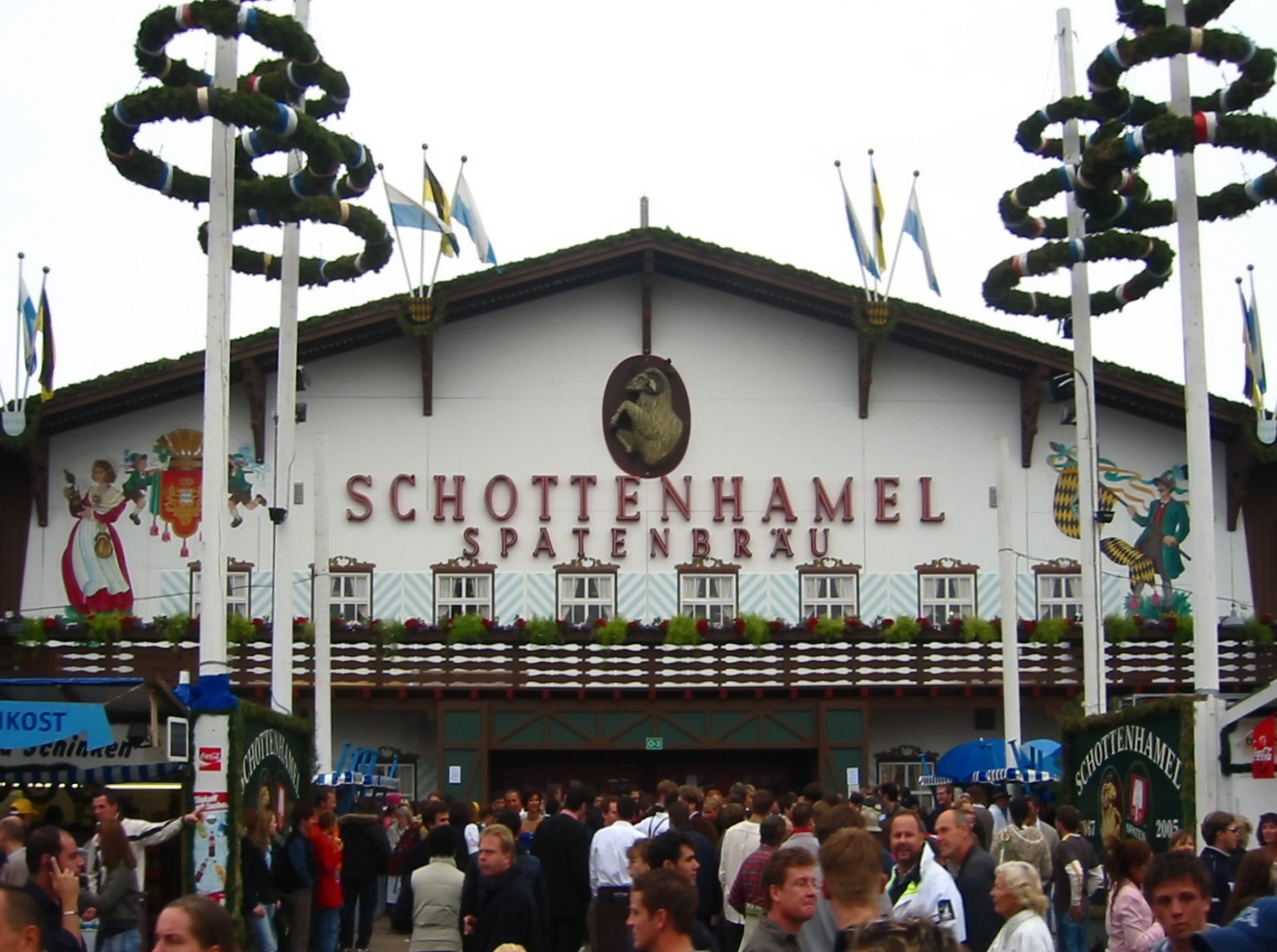
b) A “Zelt” looks like this:

Image

Would you call that a “tent?”

Anyway, you should know what Schottenhamel and Hippodrom are before you go to Oktoberfest. Schottenhamel is the rowdy Zelt, while Hippodrom is the classy Zelt. Here, what “classy” means is that people are more or less in their seats the whole time, and fewer people are ever at risk of drunkenly stumbling off a balcony.

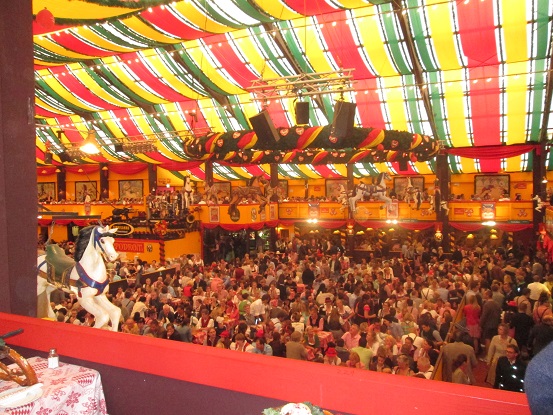
We went to Hippodrom with some friends who had reserved a table about a year ago. The tables are just big enough for 8 people to sit at them, the inside of the tent is filled with bright colors and statues, and the band is elevated above the ground floor on its own platform. Most of the people there seemed to be making the evening all about simply talking and drinking with their group of friends, and one of my German friends is of the opinion that that’s mostly how things go at Hippodrom. Here are some views of the inside from our table:

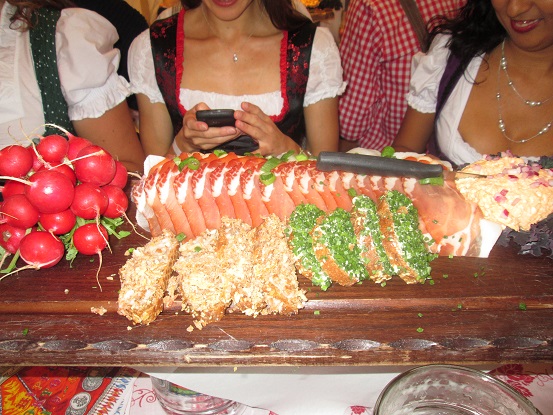
IMG_1304IMG_1309

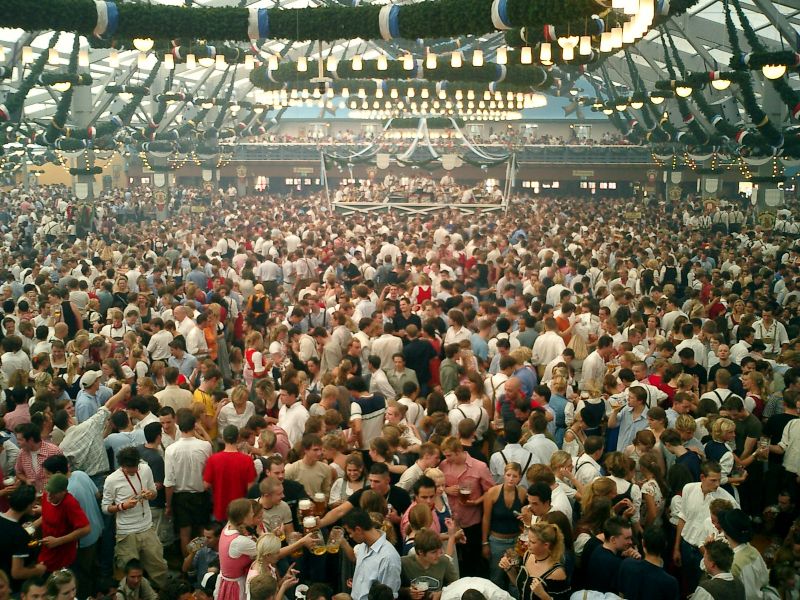
Shottenhamel, on the other hand, is more of a party-with-randos tent. We were there for 3 hours in the morning (9am-noon), and it was definitely rowdier than Hippodrom. Maybe 20 minutes after we sat down on the second floor, a guy a few tables down climbed up onto the railing and lifted his glass, looking around. Instantly, everyone around us began cheering and chanting for him to drink his whole liter of beer without a pause. He started, and kept drinking as the cheering turned into an excited roar. Halfway through, two of those big security guys from before showed up and tried to drag him down from the railing. But, the guy wasn’t ready to leave. He finished chugging the beer while fighting off security with his free hand. Finally, he finished the beer, and the crowd roared approval while security dragged him down the steps and threw him out of the Zelt. This happened, plus or minus the security guys, about every 20 minutes. Here’s what the inside of Schottenhamel looks like (I didn’t bring the camera that day, so here’s something from Google images):

schottenhamel-2

4. You can only get into most “Zelte” with reservations–months to a year in advance. I don’t have much to say about this, except that we’re extremely lucky that our friends had space free at the table they reserved a year ago. This is just something you should know before you go–it’s never too early to try to get seats in a Zelt.

5. Oktoberfest is when Munich lets itself go absolutely nuts. A friend of mine was yelled at by his neighbor when he threw his garbage in the dumpster at 8am, because it made too much noise. Housework on Sunday is illegal for the same reason. Walk around the city during the week, and you see people passing the time simply by sitting and looking at one another. Or, they’re in a park, lying on the grass. And that’s it. If it’s the end of September, though, and you hear this song, then you’d better pick up your beer and jump up onto a table: