The Drawing Board

As I wrote a few months ago, I’ve been trying to get into a Master’s program at LMU Munich called “Logic and the Philosophy of Science.” Two amazing people provided recommendation letters, I submitted a “published article” of mine, I tweaked my resume for an academic submission, and I ran down my inspiration in a cover letter. And then I waited a couple of weeks.

Well, I didn’t get into the program. It’s a real shame, because what I would have gained from it would have been really useful in carving a unique path through the rest of my life. Not many people apply a Master’s in Logic and the Philosophy of Science to the business world. At least, they don’t according to LinkedIn.

What I received from the program coordinator was an e-mail that said he regrets to inform me that I wasn’t admitted, and that he’s sure I understand that he can’t discuss application specifics with individual candidates (maybe if I can transcend my individuality, then he’ll tell me?). That sounded like a lot of generic blah blah, so I e-mailed him about the rejection, anyway.

“I appreciate that you cannot comment on my application specifically. Might you be able to offer me a few descriptors of the ideal candidate? I will be able to use the information to strengthen myself for my future.”

I thought I was sly. Of course, if he tells me about the ideal candidate, then I can cross check that profile with mine and figure out why they didn’t let me in. It didn’t work, though. I sent that e-mail 24 days ago and haven’t received a response.

That’s just an inescapable bummer of competition for which people determine the results subjectively–most of the time, you have no idea why you win or lose. Maybe my article wasn’t published enough, maybe my background isn’t non-business enough, maybe my goals aren’t academic enough, maybe 500 better versions of me also applied for the program, or maybe the guy in charge got ripped off by a car salesman named Ryan one time. I’ll never know. The program is like, two years old, so I can’t find alumni, yet.  Maybe I could get to know a good sample of current students, but there would have to be 0 other useful degree programs out there for me to devote that kind of time.

Anyway, this post isn’t about solving the rejection problem. It’s about what I’m doing now that I’m back at the drawing board.

Here are the decisions I’ve made:

  1. Learning to speak German is the most important thing I’m doing right now related to my career
  2. Getting my Master’s degree is more important than resuming my career with a conventional full-time job, right now
  3. I want to start making money again, soon

And here is how those decisions affect the way life plays out for me over the next few years:

Learning German is the Most Important

This one’s easy. I keep taking German classes, keep speaking German when I’m with Germans, keep watching TV, and keep refraining from skipping the German-language ads on YouTube. I’ll be done with class in January or February (depending on how long Winter Break is, and what our January trip to Mexico will do to my class timing). That puts me right in the beginnings of university application season and internship application season. Mmmhmm.

Getting a Master’s Degree: More Important than Full-Time Work

Right now, this means I’m looking for scholarships. In practice, these are living stipends, since university education in Bayern is free. But, they’ll make wages and hours less important when I seek an internship, so I can focus on skill building.

In a month or two, I’ll be working earnestly on my applications for admission.

In January, I’ll apply for more Master’s programs. The local universities are Technical University of Munich and, of course, LMU. I’ve identified three programs worth pursuing so far:

  1. Consumer Affairs: Described in a way that sounds like “psychology of consumption.” In any case, it’s a program that teaches marketers how to get to know consumers more effectively. Delicious.
  2. Economics: If your background is in business, and your future is in business, you can’t go wrong with Economics. An understanding of the ways in which the world around a company can effect that company’s business can only help an aspiring business leader.
  3. MBA: Yep, I’m considering it. My heart is changing, because I’ve started to see this degree in a light similar to the one in which I saw Logic and the Philosophy of Science. That is, one of the best ways to practice philosophy is to discuss philosophy with others who are interested in discussing it. I’m believing that might be a similar trait of business management.

I’ll have finished learning German formally by this time, so I’ll also be investigating German-language Master’s programs. Ja wohl!

I Want to Start Making Money Again, Soon

I’ve been here 4 and a half months, and I’m becoming tired of spending my savings without ever replenishing them. So, while I’m looking at scholarships, I’ll also be looking for part-time work. Corporate internships and temp jobs are pretty much out of the question, because obtaining those would require a level of dedication (sending out a million CVs and networking so that 10 people give me interviews) that would preclude learning German and applying for college. I’m not really competent in German, yet, so that leaves the jobs that only need people who speak English. Namely, I’ve considered these so far:

  1. English Teacher: Following in the footsteps of every English speakers who’s lived in another country, ever, I could teach my mothertongue to eager youngsters and jaded oldsters alike. There seems to be a respectable demand for people like this ,here, but I may need to get certified (spend 250 EURO on a CV line), and I’ve heard that working hours are unpredictable and occasionally really disappointing.
  2. Tour Guide: I can be a supremely enthusiastic showman in front of groups of tourists! And I know some Chinese, so at least 95% of my clientele would be in for a pleasant surprise. Bonus points for this one, because it would let me exercise my marketer chops.
  3. Transit Authority Information Rep: You know–one of those people at the big train stations who tells terrified out-of-towners where to go?
  4. Guy Who Throws Luggage Onto Airplanes: The bottom of every totem pole is always interesting, and as part of a repetitive process, I could figure out a thing or two about process management. Who loves Gantt charts and bottleneck analyses? This guy.
  5. Garbage Man: I’ll do it. You watch me do it.

So, that’s the state of things in a nutshell. Whew–glad I wrote this stuff down.
Homelandsick: Missing Things Always Happens, Even if Culture Shock Doesn’t

People miss things when they leave their country to live in another one. It’s a fact. I’m sure if you asked Science, it would agree with me, so you might as well not even waste your time.

As I was saying: whether or not you experience proper culture shock (or more esoterically: the out-of-towner heeby jeebies), you will undoubtedly regret that parts of your old life aren’t parts of your new one. And what’s really cool is that, if you’re not living abroad right now, then you probably have no idea what those parts are. Total surprises, all of them. For me, at least. As an American (read: Texan) living in Munich, Germany, I can tell you what might make an American (read: Texan) sad about living in Munich, Germany.

I’m not going to say “friends and family.” That’s because everyone misses friends and family. And “everyone” includes me. In fact, if any person has friends and family back home to miss, then they miss them without an atom of a doubt. That feeling is so universal that, when I ask a person what they miss about the old life and they start to say “Fr-,” I instantly pass out from boredom.

Let’s talk about the interesting stuff, then. You know what I mean–the stuff we can live without but, dammit, just don’t want to. What I miss more than anything are the cost and availability of digital entertainment. There, I said it.

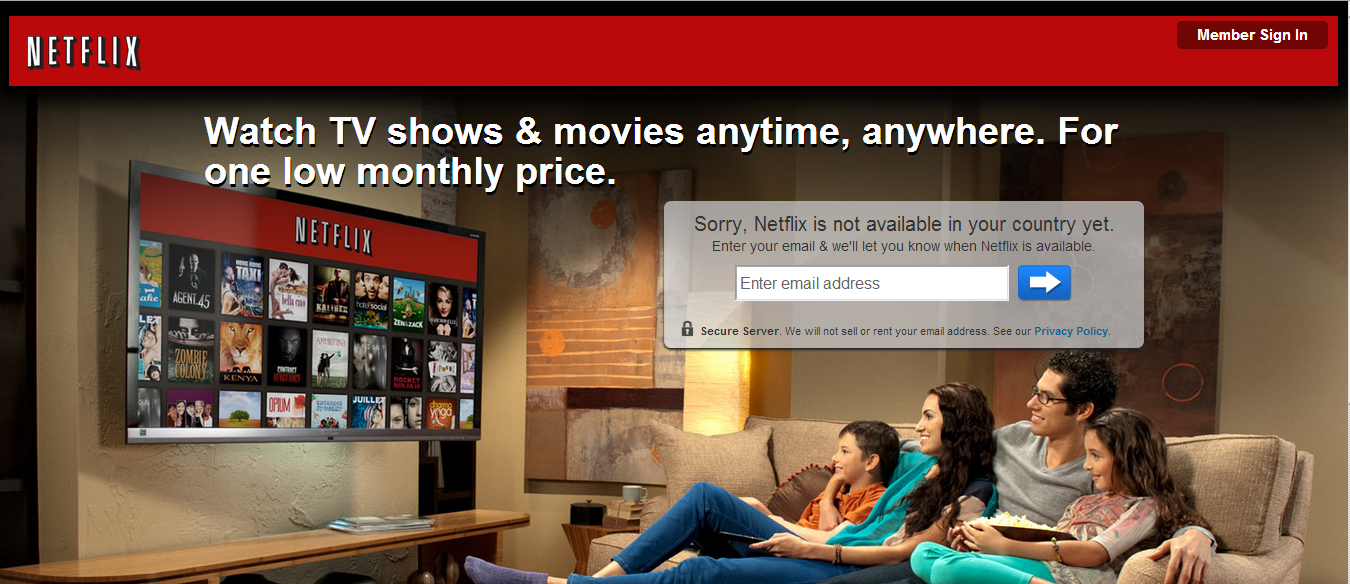
I realized this for the first time back in April, when I tried to log into my Netflix account. “Welcome back, pal! Ready to watch TV shows and movies anytime, anywhere, for one low monthly price?” Netflix is always so happy to see people.

“Am I ever!” I exclaimed, bubbling with enthusiasm.

Netflix Tells Me to Get the Hell Out

Netflix’s forehead turns bright read as it anxiously tells me to piss off.

And then, “Wait a minute. Oh shit man, since when are you in Germany? Dammit, I shouldn’t even be talking to you right now. Get out of here before you get us both in trouble.” Netflix’s forehead was bright red, presumably from rage against my audacity, so I discretely closed my browser window and tried to forget the whole thing ever happened.

I realized it again immediately afterward, when I tried to log into my Hulu account. “Whoah, buddy,” said Hulu, “Where you think you are? America?”

“No, sir,” I sighed as I closed down my Web browser and crawled under my bed for a nap.

Then I tried to listen to some music on YouTube. I believe I was trying to show Roxana how badass Volbeat still is. “Sorry!” answered YouTube, “We can’t show you that, now! Because Germany.” I decided to hang up the towel for awhile. After all, Munich has beer and parks. Sweet mother of God, does it have beer and parks.

Last month, I regained my itch for music exploration, though. Spotify wouldn’t let me down. I was sure of that. It started here in Europe, after all.

Spotify totally let me down. After 10 hours of listening, it sent its little text-window bouncer to greet me. “Time’s up pal. Pack it up and come back next month.”

Good grief. Well, I guess I’ll have to do this the old fashioned way. Get over here, iTunes.

“Hey buddy, what’s up?” asked iTunes.

“Well, Germany won’t let me watch movies or listen to music. I’m kind of hoping you’ll help me out. What do you have available?”

“Oh my, everything! I’m the U.S. version, after all!” replied iTunes, elated as ever.

In walked Roxana. “Hola, amor! What are you doing?”

“Looking at movies on iTunes. Hopefully something in Horror. Need that adrenaline, now. Want to watch something?” I asked.

“Sure! Let me pay for this one, since I can use my German debit card.”

“Oh,” interjected iTunes. “She’s gonna pay?” Then iTunes sighed, “You’ll have to get in touch with my German friend. I’m not allowed to sell to other countries. Gotta have that American debit card!”

Aw, you too, iTunes!? I switched my iTunes location to Germany.

“Guten abend!” exclaimed iTunes’s German friend. “Was kann ich fuer Sie tun?”

“Well,” I said, “we’d like to rent ‘Mama’ please.”

“Ah so! Es tut mir leid, aber ich habe kein Film dass ‘Mama’ heisst. Bitte fragen Sie meinen amerikanischen Fruend.”

Dammit. Okay, well we can probably solve this problem using my debit card and the U.S. iTunes store. Let’s give that a shot.

That one actually worked. We watched “Mama” that night. For $4.99 USD, more than half of what it costs to stream Netflix for a month. On the bright side, we could have watched the movie all we wanted before the 24-hour rental time limit expired.

But “Mama” wasn’t even a good movie. So we only watched it once.

Oh, and they also don’t have “Game of Thrones” over here. Wound sufficiently salted.

_______________________________________________________

Update July 2014: They totally have “Game of Thrones” here, now.

Wow, That Was Pretty Easy

Germany gave me a Visa, today. I haven’t reached my ultimate goal, yet, but this Visa is valid until April of 2014. So, this is definitely a valuable step en route to my ultimate goal.

It’s a Language Student Visa. Obviously, it allows me to stay here while I learn German and complete my metamorphosis into a pork-eating, beer-drinking, symmetry-loving, no-shoes-in-the-house deutschmann. If I’m admitted into LMU’s Master program, then I’ll be upgraded to a Student Visa and granted permission to stay here until October 2015. If we stay in Germany after that, I’ll use my new education and German fluency to find a job and obtain a Residence Permit for Work. For now, though, I have a Language Student Visa until April 2014. So let’s focus on that.

Shocking to me was how easy and fast it was to get this Visa. Well, it’s not necessarily easy to get a visa in Germany. What I can say more certainly is that it’s easy for a U.S. citizen to get a visa in Germany. The U.S. is a member of a group of countries whose citizens don’t need visas before entering Germany. We get 90 days for free, during which we can mess around with the visa requirements and apply while we’re here. I’m definitely going to come up with some theories about why these countries are on the list (unless I find an actual fact about it first), but not now. If you’re curious, here are the other countries:

  1. Andorra
  2. Australia
  3. Brazil
  4. El Salvador
  5. Honduras
  6. Israel
  7. Japan
  8. Canada
  9. Monaco
  10. New Zealand
  11. San Marino
  12. South Korea

Without knowing at all what I’m talking about, I’ll hypothesize that the motivations behind that list are talent attraction, humanitarianism (refuge), and political negotiation. Now, let’s hop off this tangent and get back to how getting this visa was easy. First, here’s a list of my requirements:

  1. Passport
  2. Passport photo
  3. Proof of German Health Insurance
  4. Proof of enrollment in a language school
  5. Proof that I won’t be broke before my visa expires

I started applying for this visa about two weeks ago, 70 days after I got here. Since I had 90 days to obtain a visa, that puts my procrastination factor at .78. I received my visa today, 94% of my way to the deadline, immediately after I submitted my application for it. So, why didn’t I receive the visa back at the 78% point? Two reasons:

  1. The “Student Application Visa” is a phantom tip
  2. Mother F#@$*& Heatlh Insurance

I asked for a Student Application Visa, hoping it would give me time to apply to LMU. After Desk Lady’s head exploded, she said that what is possible is a Language Student visa. All I need to do is get a note from the language school that confirms that I’m enrolled. Oh, okay.

Oh, and there’s a problem with my health insurance. I took out a policy with Techniker Krankenhaus–a popular public firm that caters to students and employed people. They arranged for my policy to activate when I begin the Master’s program. In October. “What will cover you between now and October?” asked Desk Lady.

“Dammit,” I replied.

So, I went home and learned a little about some of the private companies here who offer short-term policies. These are really just red-tape policies, right? I can manage safety for three months, I think. So, I don’t care what they offer, as long as Germany considers them legitimate and they are inexpensive. I “applied” with a company called…something to do with “care.” Don’t ask me.

Within hours of “applying,” I received my policy in pdf form. That was two days ago. And today I have a visa.

The Dumbest Thing in the World (Or, How to Become Homeless in 1 Easy Step!)

I think it’s locking yourself out of your house. Before living in Germany, that one never would have occurred to me. Because it sounds preposterous.

In the U.S., you have to manually lock your door from the outside when you leave your house (unless you live in small town Texas, where you don’t even do that). That means you don’t need to realize your keys are missing until you can’t start your car.

Doors in Germany are locked by default, and can’t be permanently unlocked. This demotes the humble doorknob to “thing you can use to pull a door open.” Job automation truly does hit close to home, these days.

To those of us used to those noblest of doorknobs who work doubles as locking mechanisms, this means we don’t realize we’re missing our keys until we’re homeless. I’ve been homeless three times since moving here.

The First Time

Melodrama aside, the first time occurred as Roxana and I moved into our apartment. We had just carried a load of things from our temporary place, and I was ready to start building some sweet Ikea furniture, cursing like a goddam sailor. Roxana wanted to make another trip to the temporary place, so off she went, leaving me to my LACK bookshelf and 5,000 pounds of cardboard.

I promptly set to prepping the cardboard for disposal. If there’s anything that makes me crazier than dirty dishes, it’s idle cardboard in the workplace. I bundled it, tucked it under my arm, and banished that useless evil to the garbage in the courtyard. Then, it hit me so suddenly I felt psychic.

Oh, dammit.

But no big deal, right? Roxana was just down the street. She’ll be back soon. She was back soon, but I sat on the stoop for 40 minutes that rainy day, jumping at every sound of footsteps along the sidewalk. Like a puppy whose family is on vacation.

The first time was kid’s stuff, I admit. 40 minutes is almost no time, but that didn’t stop my mind from wandering to places like “she’ll take a nap over there and it will be hours before I can get back in.” I didn’t have my phone, and neither did she, so that was a possibility. Anyway, the second and third times were meatier experiences.

The Second Time

This took place maybe a week after the first time. Maybe 4 days, so sue me.

We didn’t have any connection to the Internet, so I had been making daily trips to a nearby coffee shop to use theirs and spend a crapload of money on coffee. I can order the pants off a cup of coffee in German, now. Ich moechte bitte eine tasse kaffee. Kleine, und zum mitnehmen. I haven’t learned how to say “booyah” yet, however.

Anyway. This time, the “dammit’ hit me the second I closed the front door behind me. It’s 1pm, and Roxana won’t get home from work until 7pm, so that was one hell of a dammit. After I stopped hating myself, though, things weren’t bad. I was on my way to drink coffee and use the Internet, after all. And I always make sure I have a book and my iPod in a backpack when I leave the house (making it really stupid that I can’t say the same thing about my apartment key). So, if bored came to really bored, I would still have The Red Wedding and the sweet soothing arrangements of Christos Antoniou to occupy my thoughts.

Long story short, I read e-mails and the news at the coffee shop, and then got my Westeros on at Luitpold Park. No bigs.

The Third Time

This dammit led me to a small, albeit fruitless adventure around Munich about 5 days ago. That puts it about 2-3 weeks after the second time.

Remember my last post, when I said that my work to get my Student Application would begin “tomorrow?” What that meant was that I planned to apply for a health insurance policy. Documents in hand and book in back, I set out to stake my claim on a future in Germany. Boy, was I proud.

I was proud, that is, until the second my front door shut behind me. Dammit.

The time was 1pm, again (hey I just realized that that’s 13:00–that’s spooky, right?). Armed with only an account of Dorne’s vengeful spite and some minor errands, I had to make the best of 6-7 hours. Let’s get to those errands, huh?

For once in my life (and I would bet the life of the universe, as well), accomplishing something as mundane as taking out a health insurance policy required almost no time at all. I type that for you now without even a hint of exaggeration. It took me 5 minutes in that office to apply for a policy. Add the 15 minute walk/subway trip to Hauptbahnhof, and the whole thing drained 20 minutes.

The time was 1:20pm. Armed with only an account of some spoilers I can’t conscientiously put to text and maybe one more errand, I had to make the best of 5:40-6:40 hours.

“I’ve got it!” I enthusiastically proclaimed to myself. “I’ll sign up for more German classes! Get that out of the way!”

No luck. The language school was closed for the entire day, since the German weekend hasn’t been standardized, yet. About 20 minutes from Hauptbahnhof to Rosenheimerplatz was all it took. All of those mental exclamation points, wasted on a closed office.

The time was 1:40pm. To make the most of the rest of my day, I did what I think any warm-blooded Muenchner would do in my position on a sunny day like that one. I bought a beer and went to the Englischen Garten.

What the Last 30 Days is Like

You may already know that U.S. citizens (and those of some other countries) can live in Germany for 90 days without any type of visa before the country gives them a 3-month timeout (they make you leave the EU for 3 months). The last of my 90 days is July 4th, and I don’t want to sit in timeout, so June is really busy.

I’ve finished my first major task: deciding which visa I need. Mostly, I accomplished that with individual research. Funnily enough, asking people for advice about getting a visa is almost completely fruitless. Many people I’ve met are here for work, so all they know is that someone in a suit cut some red tape for them and now they’re living in Germany. Others had to endure really strict immigration processes that required them to have a visa before they even set foot in the country. And others just spread random second-hand fantasies and phantom tips.

“I know a guy…”

[He probably doesn’t know a guy]

“…who just told the government…”

[Sure. I’d love to meet Mr. Government if he’s ever available.]

“…that he’s a freelancer. So they just gave him something called a ‘Freelancer Visa,’ and now he can stay here!”

[They didn’t ‘just give him’ one. One of the bundle of requirements of a ‘Freelancer Visa’ is that you prove that you’ve been contracted for 3 projects at the time you apply for it.]

Many of the second-hand tips are like that one. They begin with “Have you heard of a [X] Visa?” Then, they make it sound like the German government is just giving them away to people with faces. Those tips are problems, because they can make you think that getting a visa is easy or worse, quick, and that you can wait a little while before you start applying for one.

So I’ve relied mostly on the Internet for my research. Forgetting about travelers’ blogs, because they really just offer more phantom tips, I set my sights on government resources. First, Google led me to the US Embassy’s residence permit tips. They give really general advice–gems like “yeah, you need a permit after 90 days,” and “go talk to the Germans if you really want to know the requirements for a visa.” Nice. Germany’s official resources aren’t any better. They offer super lists (read: comprehensive lists) which, if followed, could get anyone in the world into Germany. I know that some of those requirements don’t apply to me, so I had to keep looking. Finally, I found the best resource at the University of Munich’s website.

Anyway, the visa upon which I’ve decided is called a “Student Application Visa.” It gives me three extra months to apply to a university. Then, once I’m accepted, it becomes a normal student visa that allows me to live in Germany for the duration of my time with the school.

My plan to remain in Germany relies on my accomplishing three things in the next 20 or so days: obtain a student application visa, get into an LMU Master’s program, and book the next 6-8 months of German courses.

1. Obtain a Student Application Visa

I’ll be getting this one going tomorrow morning at 7am, across town, since “early morning” and “across town” are parts of a universal phenomenon that determines how we work with governments. Mostly, this is about filling out easy forms and showing my passport to people who glare at me. But, I just learned that I need German health insurance before I can get a visa, here. So far, getting insured sounds easy and cheap (EURO 50 per month is what I keep hearing). I’m wary, though, since that could just be a phantom tip.

2. Get Into an LMU Master’s Program

I’ve always known I would eventually go back for more education. Academia is just so tasty and theoretical that a second round needs to happen in the middle of my career to prevent mental atrophy. Now is a good time–I’m in another country, I don’t have to leave a job to make it happen, the local university is really good, and they offer a really interesting program–so I’m going for it.

Coming from the undergrad business world, I certainly considered the MBA. But, I mostly floated back and forth between “maybe” and “no,” never actually breaching the positive end of the argument. As I read and asked people about getting an MBA, I always encountered the same pros (not always all at once, but I never encountered other pros). They are 1) the letters “MBA” on your resume, 2) personal connections and 3) return on investment stemming from 1 and 2. While those three are no doubt useful benefits, they are not benefits I need from my education. Well, I admit that ROI is a factor I need to consider, but I think I have a pretty low threshold for “acceptable ROI,” and ROI is a weak factor for any program above that threshold.

As I researched the universities near and in Munich, I tossed around Economics and Psychology, believing they could make me a better marketer and, one day, an awesome marketing leader. At once, though, I noticed a strange-sounding Master’s program at the bottom of LMU’s English-taught programs list: Logic and the Philosophy of Science. I had to investigate; it sounded like a program  rooted in questioning the ability of science to deliver Truth. God, that’s tasty.

It turns out that’s, in large part, what it is. The program’s informative resources previewed its subject areas.

  1. Philosophical Logic
  2. General Philosophy of Science
  3. Philosophy of the Special Sciences: eg “Philosophy of the Social Sciences”
  4. Philosophy of Logic and Mathematics: What is the role of logic in thought and reasoning?
  5. Rational Choice and Formal Epistemology: eg Formal Rationality Concepts in Decision Theory and Social Choice Theory
  6. Analytic Philosophy: eg “Philosophy of Language” and “Philosophy of Probability”

GOD, that is tasty.

If I am accepted, I’ll use what I learn from the program to develop ideas and perspectives related to conducting market research, analyzing marketing data, employing appeals to marketing audiences and markets, and evaluating different marketing plans before launch, when there are more than one option.

In short, I’ll use the program to be a better specialist in the short term, and an awesome leader in the long term.

3. Book the Next 6-8 Months of German Courses

6 more months will get me through B2 level (I just finished A1, and the last possible level is C2). That’s where many tell me I should stop, since it’s where the practical German ends (for instance, future tense starts in C1, but nobody uses future tense, here). 8 months gets me through C1. That’s where I want to stop, since I want to be able to be clever. Even teachers say C2 isn’t worth it unless you’re a linguist, so I’ll trust them on that one.

I studied A1 at Tandem Munich. 1 unit (2 months) costs 1,090 Euros there. I will be studying A2 and probably all of the rest at the Muenchner Volkshochschule. One unit (2 months) costs 460 Euros. From what I can tell, the secret behind the price difference is that the German government subsidizes the VHS. It’s nice to know that life still involves some easy decisions.

Anyway, this is the easiest step. Every few weeks, I go to the VHS and enroll in a new German course (courses aren’t available much further than 2 months ahead of time). The challenge is dedicating myself to going to Rosenheimerplatz once a week to make sure the classes don’t fill up before I can enroll. It’s insane how quickly VHS classes reach capacity.

Well, that’s it.

Without spending much time on the sign off, I’ll just say that I hope all of this works out. Wish me luck.