If you’ve read my first post, you know that I began life in Munich without a phone (having given mine back to my former employer). Now, I have one, since coordinating activities in this city would take about 10 times as long without one. It’s that one Blackberry that the dinosaurs invented, and my “plan” gives me 100 minutes of talking per month, 100 texts per month, and 200 mb of data per month. YouTube’s gonna need a few extra servers to handle all of the requests I’ll be throwing its way.
Author: Ryan
Post #6: Getting Yelled at by an Old German Man: A How-To
If you want an old German man to get upset and yell at you, two things need to be true. 1) You need to know very little German and 2) something about German society needs to confuse you. Once you have those things, that stern reprimand you always wanted is just a metro ticket machine away.
Overgeneralizations aside, this is the story of what happened to me, yesterday.
It’s 5pm and I’m leaving class. In an hour and twenty minutes, I’ll be meeting Roxana at the train station so that we can take the metro to the Isar River and drink beer and eat pretzels (you know, as we Germans are wont to do).
Right next to the school I attend is an automated kiosk that sells metro tickets. I’m after the kind that lets you ride the metro an unlimited number of times around most of Munich for one week.
I tap a few on-screen icons in a way which I think roughly translates to “I would like one week-long pass to ride the metro around Munich, please” in automated machinese. However, what I really couldn’t stop saying was “I would like a week-long pass to travel to other cities in Germany by the train, please.” My school doesn’t offer a class in this language, so I’m stumped.
I decide to call Roxana to see if she’s purchased something similar in the past. She hasn’t but she wants to help, anyway. So, I start reading screens and narrating my progress to her.
Roxana: You want a pass that lets you travel among 2 or 3 rings inside Munich.
Ryan: When I tap “season pass–weekly,” it wants me to input a destination, like a city or something.
Roxana: Well, that’s-
Now, behind me, I hear some loud German words in a male voice. Distracted by them, I turn to investigate. A grumpy man-face greets me, and I can tell the words are directed at (or are at least about) me. I’m a little confused, but I assume he’s trying to give me instructions. Something like “press that button, dummy.” But he’s not. I apologetically ask “Englisch?” and he responds with “Get off the phone if you’re going to use the machine! I need to use it!”
It’s clear he doesn’t perceive the relationship between my phone call and the adventure I’m on with the machine. I shrug at him and start to say “I am on the phone asking for-” and he says “Go!”
Now, my temper is a little short, but I’m in a country that’s not my own. So, I hit “cancel,” step back, usher him forward, tell him “Go,” and walk away.
So, that’s it. Just a story about an angry guy for your entertainment. I’m trying to learn something from the experience, but I’m not sure I can avoid the same event in the future. If I need to accomplish something, and I don’t know how to do it, yet, then I think I have to hope that whomever is nearby will teach me how to do it. Or someone will have to yell at me and I’ll have to learn some kind of guilt trip technique.
The universe heard my wish later, though, when I met Roxana and we both tried to figure out how to use the machine in the train station. We spent about two seconds in confusion when the guy next to us offered to help. Now, I know how to use that machine. So it ended well. Viele dank, train station guy!
Post #5 – Two More Classmates, Hideki Still on his Own
Right now I would be writing about how many native Spanish speakers live in Munich, but something important developed in my German class, today. So, I’m going to save my excitement over the extra utility of my childhood Spanish classes for another day.
Two new people joined our class. I’ll call them James and Nastia. James is from the US (Los Angeles) and only speaks English. Nastia is from Belarus and only speaks Russian.
Hideki is still from Japan and only speaks Japanese.
These additions are interesting because they add balance to our roster that could be either amazing or terrible. You may have read my second post and remember that our class communicate kind of like this:
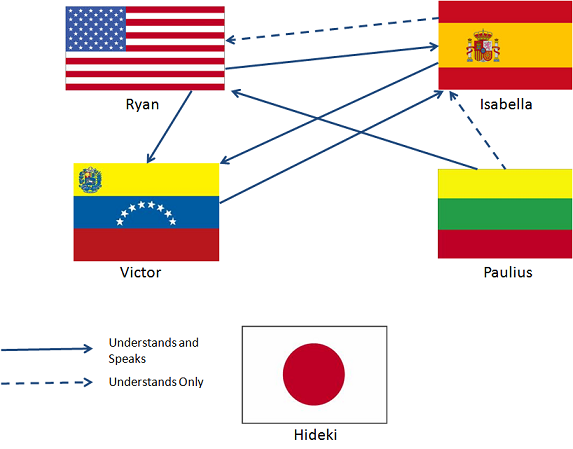
Isabella, Victor, Paulius and I make do with our various language skills and communicate with words, while Hideki is a complete boss and manages to fit in without using words (or understanding them). Seriously, that guy rules. What will happen now that our two new classmates have joined us, though? My hope is that we have more perspective. We can all compare California with Texas, and figure out how diverse the US is. We can also compare Lithuania with Belarus and learn what the two countries share besides Russian. All the while, Paulius is translating to and from Russian, and I’m translating to and from Spanish. Even typing that sentence made me want to do jumping jacks.
Isabella and Victor give us hope. From the two of them, we’ve been learning how Venezuela differs from Spain (including how Spanish differs between the two countries). What I’m worried about though, is how foreboding our class’s newfound balance is. Behold…
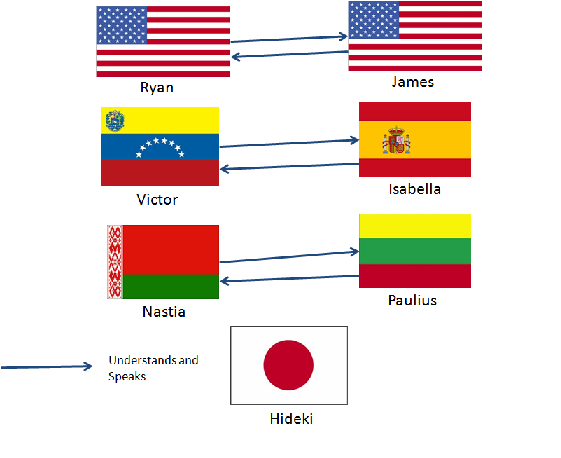
With the addition of these two new classmates comes the creation of comfort zones. One zone speaks English, another Russian, and a third Spanish. James and I get to practice our English, Isabella and Victor get to practice their Spanish, Nastia and Paulius get to practice their Russian, and Hideki takes residences in zone #4–the ultimate discomfort zone.
Hopefully that’s not how things work for us. Hopefully the addition of two new classmates comes with the addition of two new perspectives and languages we can all share. Hopefully we can keep getting drinks and playing nonverbal guessing games with Hideki the Boss.
Also, I’m not sure where to write this, since I don’t foresee a whole post dedicated to it, so I’ll mention it here. We were talking about sports we like to play the other day, and when I said “Ultimate Frisbee” the entire class died laughing. Welcome to Europe, American.
Post #4 – An Obligatory Post about Food (Or, My Blog is Finally a Blog)
Every blog has a million of these, so now mine has one. Let’s do this thing.
Munich is a mulitcultural city with tons of food options yatta yatta blah blah GERMAN FOOD.
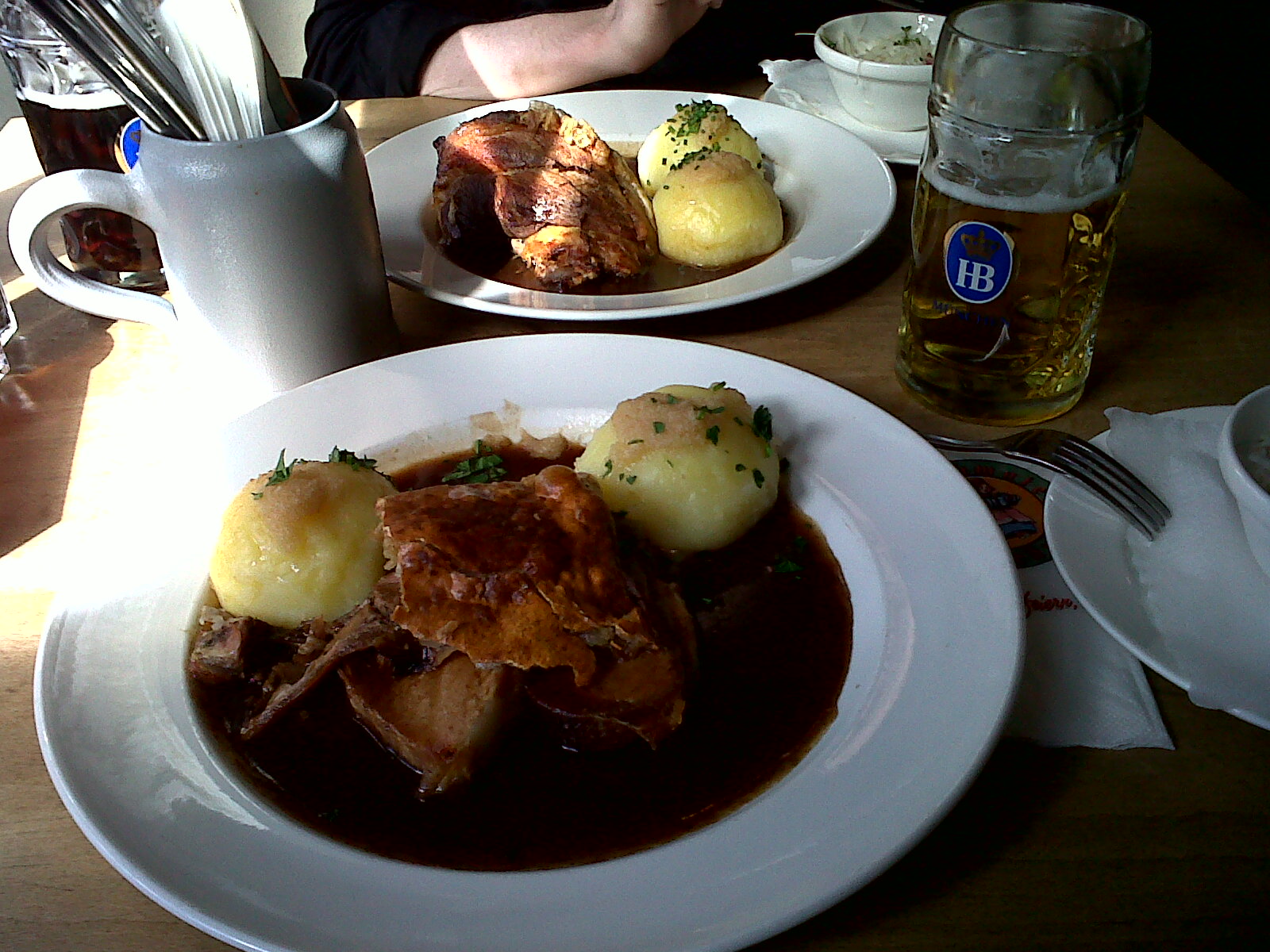
Just look at those things.
Roxana and I made it our goal to eat something super German this weekend, and we think we did it. Closest to you in the photo is what Roxana ordered, and my meal is obviously across the table. Both are different cuts of pork, prepared exactly the same way: with a sauce made from dark beer. The yellow mounds on each plate are mostly potatoes, but they taste like they use a lot of other ingredients, as well. The rich vocabulary I’m using to describe these dishes is probably telling you exactly how much we knew about them before we ordered.
Ryan: These have pork in them.
Roxana: Yeah, and they come with potato-somethings. See? Kartoffel.
Ryan: Yeah, and mit dunklebiersauce? That sounds awesome.
Roxana: I say we don’t think much about this and just order something that sounds German.
Ryan: Exactly what I’m thinking.
So, there you go. I can tell you that each dish was about the size of Roxana, so neither of us ate again for 10 or so hours. And they were extremely tasty. THAT’S LUNCH.
I’ll close with some notes about the service at this and other German restaurants we’ve visited. They won’t blow minds, so they won’t get their own post(s), but they’re interesting because they contradict much of what I’ve heard about German food service.
- Waiters and waitresses are friendly. Not as friendly as the ones in Texas, but nobody’s as friendly as those people. The waitress at the restaurant in the photo here actually said goodbye with “schöntag,” which I think is a much sweeter version of “gutentag.” She also smiled a lot. I’ve been told by many that German waiters are standoffish and impatient (seemingly, at least).
- Service seems slow at first, but it’s because waiters are being polite. They don’t check on you during the meal, because they don’t want to interrupt. Once you get the hang of flagging one down and asking for the check, the experience is really smooth. It also means you start spending more time talking to your friends in the restaurant. That’s pretty nice.
Coming up in a future post: Spanish speakers love Munich.
Post #3: A Post about Hideki
This post is going to refer to my classmates a bunch of times. If you missed my first post about them, scan it to learn whom each person is.
Hideki is the Japanese guy in my German class. As I mentioned in my post yesterday, he only speaks Japanese. So, as hard as it may sound to learn German from scratch as a westerner, this guy is having a Hell of a time. Luckily, he has a pocket PC and some translation software with him.
Anyway, his coping methods aren’t what’s important right now. What’s important is what his…linguistic situation…means for our relationships as classmates. It means that Hideki is always somehow a part of our conversations, but we have no idea how much a part of them he is. Here’s a diagram that shows how we communicate with native languages (now, at least, since our German is pitiful):
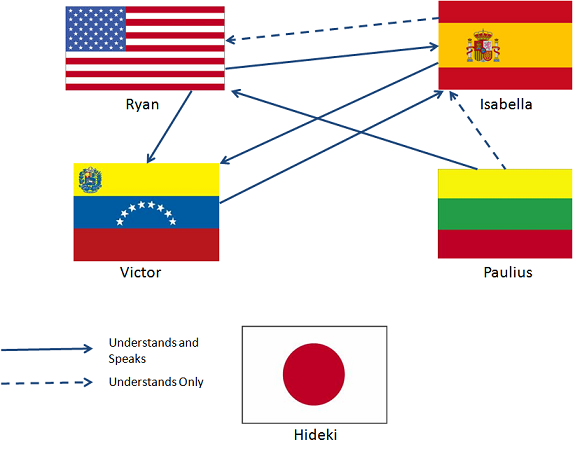
Here’s an example. Are we on the same page as Hideki, or not?
Ryan: Hideki! ‘Wie’ und ‘was?’ (Shrugs and shakes head because we haven’t learned “What’s the difference?” or “We’re confused. Do you know?” yet)
Hideki: HAHAHAHAHAHA! (while shaking head)
Either he knows what our problem is and he’s saying it’s his problem, too, or he’s telling me “sorry, I don’t know what you’re trying to say.”
We all shared a similar exchange on Monday, when we introduced ourselves and talked about where we were before Germany. He kept saying “near Osaka,” and our teacher kept asking “Yeah, but from where” (“Ja, und wie heiβt?”). And he kept saying “Osaka.”
That was also before we all knew much German at all. We tried playing charades to no avail. Hideki remained a mystery.
But today: Hideki, unveiled! Sort of. Now, we’re all experts at saying where we’re from, what our hobbies are, where we live, what we do for a living, which languages we know, and some other stuff. So, today, we all went through the small talk dance, again (we had teacher #2 today, and he hadn’t heard our small talk, yet). Woher kommst du? Wo wohnst du? Hast du hobbys? Was bist du von Beruf? (“What do you do for work?”) Was ist dein hobby? Wo ist deine heimatstadt? Hat deine Heimatstadt gutes Bier? Those last two are “Where is your hometown?” and “Does your hometown have good beer?” To these, Hideki answered like this:
Heimatstadt: in Mie, Japan
Hobby: Schwimmen
Gut Bier: Nein
Beruf: Wirtschaft student
His hometown is somewhere in Mie (clearer than “near Osaka!”), he swims for his hobby, his hometown doesn’t have good beer, and he’s an economics student! Great to meet you, Hideki!
I’m especially excited after today’s conversation. We’re all shaky at communication right now, as the diagram earlier in this post points out. However, as we progress in this class, we’re all going to share German, which is nobody’s native tongue. That means when we get together, the easiest way to communicate will be abandoning our native languages in favor of this one we just learned, here. That’s fun.