The Drawing Board, Explained

Last week, I wrote about the plans I’ve made since receiving the notice that I didn’t get into the Logic and Philosophy of Science Master’s program. They revolve around three important decisions. Remember them?

  1. Learning to speak German is the most important thing I’m doing right now related to my career
  2. Getting my Master’s degree in 2014-15 is more important than resuming my career with a conventional full-time job
  3. I want to start making money again, soon

If you don’t remember them because you didn’t read that post, then you can send your apologies to ohgodforgivemeryan@gmail.com. Go on. Send them.

What I didn’t do in that post is explain why I made those particular decisions. So, that’s what I’m doing right now. “Why” is approximately infinity times more important than “what,” in any case. Maybe that’s your point of view, too. And here we go.

Learning German is the Most Important Thing I’m Doing

While everyone in Bayern under the age of (I think) 50 had to learn English in school, English is not the way most people operate day-to-day in Munich. For them, it seems a bit like it is for me and about 7 billion other Texans. That is, many of us learned Spanish, but we would always prefer English and, in fact, would rarely have the opportunity to use our second language. The result is much the same, as well. Some in Munich speak phenomenal English (as some Texans speak phenomenal Spanish), but many need to focus their minds while speaking and listening, requiring that conversation remain somewhat slow and basic. It’s that symptom that everyone who learns a second language understands: until you live among native speakers for at least a few months, speaking a second language is a bit of a mental chore. I happen to be in that “native speaker” situation, while the German friends I meet here are not. So, I should learn German so that I can meet, practice and speak with the Germans.

More specifically, though, learning German will 1) let me function in German culture, 2) open up maybe 100 extra Master’s degree options which are only taught in German and 3) make me a viable candidate for employment at a “smaller” company, at which German speech appears to be the norm, intra-office.

*****Tangent: Why do I want the option to work at a “smaller” company? I’m young and want to build a unique structure of marketing knowledge before I seek a team management position. In general, smaller companies have weaker bureaucracies than larger ones, and they’re less convinced that they have all the answers already. At the smaller companies I’m talking about, the goal is to figure out how to win. Their antithesis is the large company at which the goal is to keep doing what wins. I believe you learn more (about marketing to consumers) in a shorter period of time at the smaller company, so that’s where I’m thinking I’ll head, next. All that said, “small company” is just the name I’m giving that archetypal corporate culture–the literal size of the company isn’t important otherwise.

Earning a Master’s Degree: More Important than Full-Time Work

Every single day, I feel anxious about my absence from the Marketing arena. Is Aurasma any more useful now than it was 4 months ago? Could I use SnackTools to develop an effective microsite-ad-widget campaign really quickly for a product I manage? Can I create a video for a B2B company that lasts longer than 2 minutes and retains 80+ percent of its viewers? Can I find or create a human personality to represent a company or product that people in my target audience actually admire and follow (really follow ideologically, not one-night-stand-style Twitter follow, or politically motivated LinkedIn follow)? And then there’s the mountains of consumer data companies can access with their Web Analytics suites. I miss SiteCatalyst.

With a company’s resources (and audiences), I could be answering those questions, swimming in consumer data, and honing my marketer’s edge. If you’re in my position right now, then you know that option sounds astoundingly tasty. But it’s not the best option, yet.

The best option is going back to school, and two reasons make that the case. The first is that I’ll be competing with Master’s graduates in the future. The second is that academia has a way of giving a marketer ideas that the corporate world struggles to offer. The first reason is obvious, so I’ll just take a bit of space to explain the second one.

Academia is brimming with enthusiasm and idealism. Enthusiasm and idealism foster creativity and experimentation. Creativity and experimentation sometimes lead to success and sometimes to failure, but always to a sharper mind.

Think about it: in a normal business class, you’re given a project like “develop a marketing plan to reintroduce this fledgling local TV station to its market.” Then you go figure out how to do it with your team. Only your team. You guys get to go through all four stages of team development without “preemptive mediation” from outside your team (that means managers try to help you avoid the storming phase). You get to challenge each other’s ideas using marketing logic instead of the logic of internal politics. You get to create an entire pitch on your own, so the client has to wait until the idea is ready before they can get scared and reign you in prematurely. Then, you actually get to pitch your plan.

Oh, and then you get blunt, unadulterated feedback that doesn’t have to care about morale.

And if you don’t do as well as you wanted to do, then you can learn why and apply it to your next project.

The professional world struggles to offer that kind of no-holds-barred development to its inhabitants. That is, companies sometimes need to bar a lot of holds. If my marketing experiment (read: project) fails, and the culture around my boss would look down on him for it, then he is going to feel one hell of an urge to peer over my shoulder and nix those of my ideas that he didn’t expect. So, the easiest way to learn at a company is to learn from the company–do what its employees have been doing for years and learn how well those methods work. After you do that, learning whether or not there’s something better you could be doing for the company is a major challenge. It’s a fun one, but nevertheless major.

******Tangent: Come to think of it, that “learning from the company” bit makes hopping from company to company a pretty rational lifestyle. Once you learn how your company wins, and you stop learning more, then you move to the next company and learn how it wins until you stop learning more. You can get a lifetime’s worth of good business ideas that way.

So I’ll go back to school. A year of classes followed by a year of work/thesis will be a fantastic mental exercise. Then, I’ll go back to the business world, where plan-execute-analyze-improve applies to pitching program ideas to coworkers more often than pitching products or services to customers. And by that time, the ideas I’ll be pitching will be better than they are now.

I Want to Start Making Money Again, Soon

The rationale behind this decision won’t surprise a single one of you. I came over here with an appropriate amount of savings, but over time I’m feeling anxious as my savings only decline without offset. Roxana is employed, so the worst case scenario isn’t catastrophic, but it would still take a significant emotional toll on me.

That means I would feel uncomfortable in a scenario that has Roxana bearing the entire financial burden of the relationship. She, angelically as usual, assures me that I’m worried about something stupid, but I nonetheless can’t shake the awkwardness.

So, I’m looking for a part-time job doing something in Marketing (read: something with a company’s customers). Since I don’t know German at a professional level, yet, one of my first stops is the Munich Arbeitsamt–the employment office. I want to ask them what kinds of jobs and employers in the city prioritize English and don’t mind if the employee is in the middle of learning German.

So those are they–the reasons behind my decisions. I’ll keep you in the loop on how everything goes.
Post #5 – Two More Classmates, Hideki Still on his Own

Right now I would be writing about how many native Spanish speakers live in Munich, but something important developed in my German class, today. So, I’m going to save my excitement over the extra utility of my childhood Spanish classes for another day.

Two new people joined our class. I’ll call them James and Nastia. James is from the US (Los Angeles) and only speaks English. Nastia is from Belarus and only speaks Russian.

Hideki is still from Japan and only speaks Japanese.

These additions are interesting because they add balance to our roster that could be either amazing or terrible. You may have read my second post and remember that our class communicate kind of like this:

Image

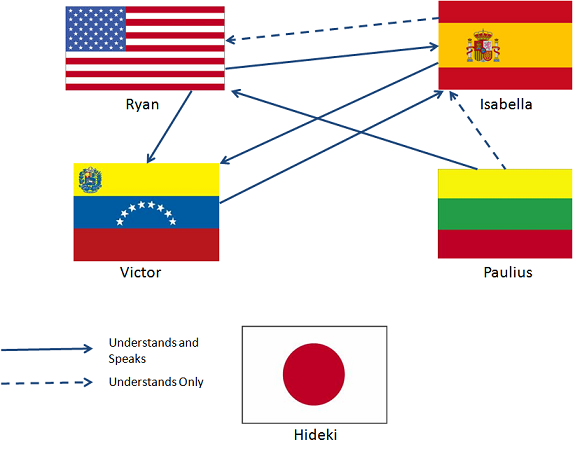
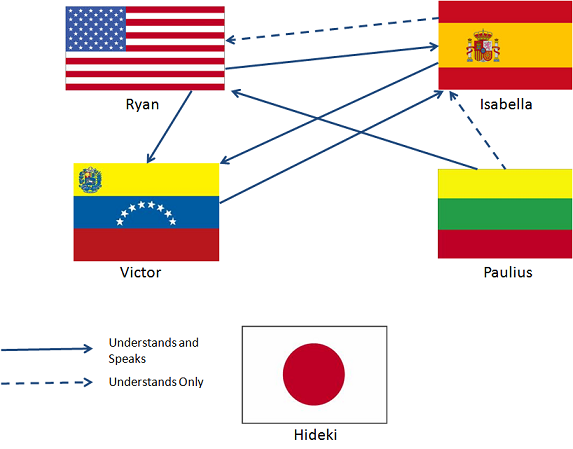
Isabella, Victor, Paulius and I make do with our various language skills and communicate with words, while Hideki is a complete boss and manages to fit in without using words (or understanding them). Seriously, that guy rules. What will happen now that our two new classmates have joined us, though? My hope is that we have more perspective. We can all compare California with Texas, and figure out how diverse the US is. We can also compare Lithuania with Belarus and learn what the two countries share besides Russian. All the while, Paulius is translating to and from Russian, and I’m translating to and from Spanish. Even typing that sentence made me want to do jumping jacks.

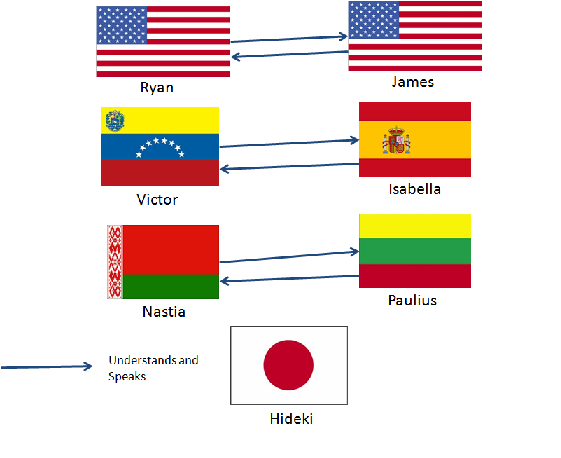
Isabella and Victor give us hope. From the two of them, we’ve been learning how Venezuela differs from Spain (including how Spanish differs between the two countries). What I’m worried about though, is how foreboding our class’s newfound balance is. Behold…

Image

With the addition of these two new classmates comes the creation of comfort zones. One zone speaks English, another Russian, and a third Spanish.  James and I get to practice our English, Isabella and Victor get to practice their Spanish, Nastia and Paulius get to practice their Russian, and Hideki takes residences in zone #4–the ultimate discomfort zone.

Hopefully that’s not how things work for us. Hopefully the addition of two new classmates comes with the addition of two new perspectives and languages we can all share. Hopefully we can keep getting drinks and playing nonverbal guessing games with Hideki the Boss.

Also, I’m not sure where to write this, since I don’t foresee a whole post dedicated to it, so I’ll mention it here. We were talking about sports we like to play the other day, and when I said “Ultimate Frisbee” the entire class died laughing. Welcome to Europe, American.

Post #3: A Post about Hideki

This post is going to refer to my classmates a bunch of times. If you missed my first post about them, scan it to learn whom each person is.

Hideki is the Japanese guy in my German class. As I mentioned in my post yesterday, he only speaks Japanese. So, as hard as it may sound to learn German from scratch as a westerner, this guy is having a Hell of a time. Luckily, he has a pocket PC and some translation software with him.

Anyway, his coping methods aren’t what’s important right now. What’s important is what his…linguistic situation…means for our relationships as classmates. It means that Hideki is always somehow a part of our conversations, but we have no idea how much a part of them he is. Here’s a diagram that shows how we communicate with native languages (now, at least, since our German is pitiful):

Image

Here’s an example. Are we on the same page as Hideki, or not?

Ryan: Hideki! ‘Wie’ und ‘was?’ (Shrugs and shakes head because we haven’t learned “What’s the difference?”  or “We’re confused. Do you know?” yet)

Hideki: HAHAHAHAHAHA! (while shaking head)

Either he knows what our problem is and he’s saying it’s his problem, too, or he’s telling me “sorry, I don’t know what you’re trying to say.”

We all shared a similar exchange on Monday, when we introduced ourselves and talked about where we were before Germany. He kept saying “near Osaka,” and our teacher kept asking “Yeah, but from where” (“Ja, und wie heiβt?”). And he kept saying “Osaka.”

That was also before we all knew much German at all. We tried playing charades to no avail. Hideki remained a mystery.

But today: Hideki, unveiled! Sort of. Now, we’re all experts at saying where we’re from, what our hobbies are, where we live, what we do for a living, which languages we know, and some other stuff. So, today, we all went through the small talk dance, again (we had teacher #2 today, and he hadn’t heard our small talk, yet). Woher kommst du? Wo wohnst du? Hast du hobbys? Was bist du von Beruf? (“What do you do for work?”) Was ist dein hobby? Wo ist deine heimatstadt? Hat deine Heimatstadt gutes Bier? Those last two are “Where is your hometown?” and “Does your hometown have good beer?” To these, Hideki answered like this:

Heimatstadt: in Mie, Japan

Hobby: Schwimmen

Gut Bier: Nein

Beruf: Wirtschaft student

His hometown is somewhere in Mie (clearer than “near Osaka!”), he swims for his hobby, his hometown doesn’t have good beer, and he’s an economics student! Great to meet you, Hideki!

I’m especially excited after today’s conversation. We’re all shaky at communication right now, as the diagram earlier in this post points out. However, as we progress in this class, we’re all going to share German, which is nobody’s native tongue. That means when we get together, the easiest way to communicate will be abandoning our native languages in favor of this one we just learned, here. That’s fun.

Post #2: German for Non-Germans

I remember learning Spanish and Chinese in American classes. The teacher would explain one of the language’s concepts in English, then define each vocabulary word in English. Finally, we would practice in the new language. I grew accustomed to that method. It became the easy way to learn.

Now, I’m in a German class full of people who don’t speak English at all. Well, that’s not entirely true. One guy kind of speaks English. And the people teaching the class know how to speak English. They can’t, though. It would go right over most of the class’s head. While we’re on the subject, these are my classmates:

  1. Isabella: Spanish girl who only speaks Spanish.
  2. Victor: Venezuelan guy who only speaks Spanish.
  3. Hideki: Japanese guy who only speaks Japanese.
  4. Paulius: Lithuanian guy who speaks Lithuanian and some English.
  5. Eva: German girl who is the class’s teaching assistant and speaks German and a little English and Spanish.

I’m changing each classmate’s name for this blog. Most of me thinks it would be no big deal to use their real names, but the paranoid part (read: considerate part?) of me thinks I should ask them if it’s okay before doing so. And I’m not ready for that conversation, yet. Hey, nice to meet you. I’m gonna blog about you. Can I use your real name?

Anyway, these teachers’ (there are two who alternate) approaches are different than the ones my American teachers used. The entire class is in German, so they speak in patterns until we’re able to infer the meaning of a word or phrase. For example:

“Ryan kommt aus den USA. Paulius kommt aus Litauen. Ich komme aus Deutschland. Woher kommst du, Isabella?”

At this point, we all infer that he’s talking about where we’re from, and Isabella just heard how to say it in the first person, so she can answer “Ich komme aus Spanien.” We all have an inkling that “ich” is “I,” “kommt” “kommst” and “komme” are all conjugations of some verb that means “to come” and when you want to say you’re from a place, you say “aus [the place].” It’s only been three days, but I’m thinking this is a really effective way to learn. My head hurts after three hours in a way that says that has to be the case. Anyway, it makes us think a bit harder about the language, and it forces us to bypass the awkward translation stage of learning a language (think in English, translate to German, speak in German).

So there’s a really good reason to study a language in its home country. Another one is that it’s crazy learning a language with people who speak different languages natively. You get to see, for example, which phonetics give Spaniards a tough time, and which structures give Japanese people a tough time (it would seem that all of them do in a Western language like German). Look forward to more about that in a future post.

Also, in the near future, I’ll write about my classmates’ reasons for being in Munich, InterNations–a networking group for expats (we’re going to some kind of night club party on Thursday with them)–trying to eat with a growing German vocabulary, and maybe the time I got sick after eating German quesadillas (yeah, I should have known better).

Tschüss!