People at Parties Abroad

…when we Americans get excited, we tend to emit a telltale “Wooooo!” sound that turns other nationalities (especially the English) into spontaneous Steve Irwins…

An English friend tries attracting nearby Americans with the telltale "WOOOO!" call.
An English friend tries attracting nearby Americans with the telltale “WOOOO!” call.

One of the great joys of living abroad is making friends with people from other countries–expats and natives alike. It’s an absolute riot comparing cultures. For instance, the English have right around 1 million ways to call a person “drunk.” I can think of 6 that we use in the States. And one of them is “drunk.” Also, when we Americans get excited, we tend to emit a telltale “Wooooo!” sound that turns other nationalities (especially the English) into spontaneous Steve Irwins who had prior been on the hunt for precisely our elusive kind. “Blimey! Lookee there! That sound means we’ve stumbled upon our first American of the night!”

One of the greater joys of living abroad, then, is partying with those international friends.

This is the beginning of series of posts called “People at Parties Abroad.” After over a year here, I’m convinced that I’m seeing patterns–patterns that tie behavior at parties to a person’s country of origin. Each post in this series will be somewhat of a straw-man portrayal of a single nationality at a party abroad. They’ll describe what I see. Over and over again. Every time I go to a party. I’ll look forward to comments about whether or not other people notice the same patterns.

I’ll start with us–the Americans–and our desire to be honorary members of everyone else’s culture, whether we’re invited in or not. From there, I’ll cover Mexicans, who want everyone else to be an honorary member of their culture, whether they asked for it or not. After them, I think I’ll cover the French, but I’m not convinced that I know enough about them, yet. From then on out, it’s just about which patterns I notice first.

If you find this even half as fascinating as I do, bookmark this page and check back often. This should be fun.

Can I Haz Ur Evening? Surprise Visits from Solicitors

BeggingGermany and, indeed, the European Union are astoundingly pro-consumer from an American’s perspective. Companies are required to send their customers snail-mail copies of announcements related to contract changes, for instance. This helps consumers sue more easily. Comparative advertising is all but expressly forbidden. Comparative ads must pass a pretty rigorous 7-part test if they are to be allowed on the air. If an illegal advertisement runs, then even the vehicle who ran it gets in trouble. If you write “Keine Werbung bitte” (“No ads, please”) on your mailbox, then the mail deliverer is not allowed to leave promotional materials with you. It wasn’t too much of a stretch, then, when I assumed that door-to-door sales and donation requests would be illegal, if not heavily regulated.

It turns out I was incorrect.

It’s happened to me three times since May 2013, and I just recently confirmed with a German friend that I wasn’t an a-hole for telling them to go away. So, I’m going to tell you the story of the most recent encounter. It stars a solicitor from what she called “The Ambulance.” Buckle up.

——-

It’s 8pm last Thursday. Rox and I had recently finished dinner and were watching some TV together. The doorbell rang. Then we heard a knock on the door.

Someone somehow found our door without having buzzed in from the outside. This was either a surprise visit from a friend, or what some would call “fishy.”

I donned the stupidest look to ever appear on a face, and looked to Rox for some imaginary answer. She had none.

Mildly annoyed, I groaned a lazy TV groan, stood up, and shuffled to the front door.

When I answered a blond girl in her late 20s greeted me with a smile and a clipboard. Oh, no.

“Hello, I’m from the Ambulance. Do you have some time?”

No, I don’t. “Sure,” I faked a smile.

Noticing my accent, she continued “Ah! Is English better for you?”

“No, I can speak German. You can go ahead.”

“Okay, great. My English is not so good, but I can try if you want.”

“No worries.”

Then, she said some things about the Ambulance, and asking for support, and would I give my signature, but I didn’t catch all of it.

“Crap,” I replied. “Yeah, maybe we should go ahead in English.”

“Okay, I will try,” she replied, sheepishly. “Well, I am here on behalf of the Ambulance. Have you ever had to use the Ambulance in Munich?”

“Thankfully no,” I replied. She seemed to expect more, but I didn’t have anything else for her.

“Ah, okay, well yes, that’s a good thing. Well, I’m here to ask for support. If you sign here, you can give as little as 3 euros per month to support the ambulance. It will help us provide better care for you if you should ever need it.”

If I should ever need it. That appeal to fear was not the first appeal she would drag from the Freshman Marketing Handbook that evening. Keep reading.

I threw out the first polite excuse that came to mind. “Ah, well the problem is that I’m a student, so my income is quite low. I’m afraid I can’t afford to give right now.”

Appeal to Empathy: “Ah, well that’s okay! I’m a student as well, and I give each month. It’s really not a problem.”

Pride in one’s employer is awesome, but it doesn’t solve my problem. “Hmmm. Well, I’m really just not sure, yet. I’ve never heard of this program. Do you have a website I can check in my free time? Can I donate online?” Maybe her cause is legitimate. I’d like to read and learn more about it.

Appeal to Scarcity: “Ah, yes we have a website. But, the problem is that, if you give on the website, then the organization distributes the money all around Munich. If you sign up with me, now, then it ensures that the ambulance gets all of the money.”

What’s “the organization?” I give her a reluctant look, to which she responds before I can give her another excuse.

“I’m coming by your apartment tonight, because I was here last year to sign up all of your neighbors. I’ve noticed that you are new, here, so I came back to add you to the list.”

APPEAL TO THE BANDWAGON FTW!!!!!

Nah, just kidding. She totally lost me on that one. Among my thoughts were these:

  1. She’s way too aggressive, and that much social pressure usually opens my altruism circuit
  2. Her challenging every misgiving I presented to her is decidedly disconcerting
  3. Emergency medical services are public, here, and the income tax is 40%+. Why does EMS still need donations?
  4. First contact with the campaign is at my front door at 8pm. No e-mails? No ads? No snail-mail? And why won’t she let me go to the website to research it?
  5. She didn’t have any fliers with her. What does that mean about people who turn them down at the door?

“Okay. Well, thanks. I understand your cause and I’ll look into it. For now, though, I’m not going to commit to a monthly donation.” Then, I pause.

After a few seconds. “Okay. Well, thank you for your time. I will come back in a few months to see if you are ready.”

Unless I find out that you guys really super need the money, then I “won’t be home” next time you come. “Okay, sounds good. Good night.”

——

Talking to my friend Katharina, today, I learned that one should “never commit to a monthly donation based on a visit to my home.” She wasn’t blown away by the experience–she said it’s happened to her a few times. But, she certainly urges on the side of caution with those kinds of causes, and confirms that there’s no such social norm that could pressure one into a commitment like that. She went on to call the activity an invasion of privacy.

Good. So, worst case scenario, this issue is just controversial, here. I can live with that.

So, I’m treating the experience like an exposure to marketing communication. Now, I’ve heard of the cause. Later, when I’m looking for local causes to support, I’ll see what “the ambulance” needs, why they need it, and what my money can do for the community.

If you’re a foreigner like me: Don’t think too hard about door-to-door solicitors. They caught me off guard, and I felt guilty for turning them down. However, doing so does not violate any prominent social norms, so Germany probably won’t hate your for it.

5 Ways Composing a CV in Germany is Weird to an American

Being a foreigner means never truly knowing when you’re about to violate a cultural norm.

As you might imagine, being a foreigner changes some aspects of the job hunt significantly. For one thing, your command of the local language is a new factor in your nervousness before an interview. Nearly every Marketing job description I’ve seen, for example, requires that a person know written and oral German and English “expertly” or “fluently.” What does “expertly” really mean? How much of the interview will be in each language? Should I demonstrate English fluency or “working professional” German on my CV? In my experience, even when I handle myself in a German conversation, it still happens through the stress and self doubt of defusing one’s first bomb in a cage full of sleeping badgers. If you’ve ever played a musical instrument competitively, imagine how it felt after you performed your solo for the judge. No matter how Flaxen the Maid’s Hair really was, you just blew “Mahna Mahnam” through a Kazoo.

More generally, though, being a foreigner means never truly knowing when you’re about to violate a cultural norm. And, because feedback is completely absent The Application Process, you often won’t even know after you’ve violated a cultural norm. Luckily, the Internet and friends are things.

The following is what I’ve learned about composing a CV for a company in Germany. Hopefully, it’s also convincing evidence that, to an American at least, it’s a very counterintuitive experience. For reference, here’s what’s most generally expected in the States:

  • Name, address, phone number, e-mail address
  • 1 page
  • Focus on accomplishments, not job descriptions
  • Be honest
  • Keep it professional–only include information relevant to the job to which you’re applying
  • Sometimes include references: names, positions and contact information of people from your professional life who can vouch for you

Keep that list in mind as you read the rest of this. We’re about to tear most if it down. Even the “be honest” one. Here are 5 ways composing a CV in Germany is weird to an American.

NUMBER ONE: The Photo

Unnecessary.
Unnecessary.

I remember quadruple checking this requirement when I first heard about it. A CV here needs to include your photo because…reasons. I’ve been told that the photo should be as basic as it gets–the background should be white and lacking any sort of design, you should just be looking at the camera, and your smile should be somewhat subdued. It’s a mug shot in which you’re kind of amused that you’ve been arrested. The rationale I was given is that those techniques make it more evident that you generated the photo specifically for your CV, rather than having grabbed one from your records or from social media. I’m not sure why that approach is better. “It just looks more professional” is probably the official reason.

NUMBER TWO: Personal Information

Personal Info They want to know everything, here. Besides your name, address, phone number and e-mail address, they want to see your nationality, birth date, and marital status. Nationality makes sense to me from the start. In a foreigner-friendly workplace, they might want to get an understanding of the paperwork you’ll require before they investigate you further. Additionally, if they are going to be paying you less than a legal minimum*, then they have to prove to the government that you are better than a German would be at the job.

I believe marital status is useful, because the German government require that companies offer some relatively costly benefits to new parents. Mothers, for example, are required to take the 6 weeks prior to birth and the 8 weeks following it off at full salary (The Local). Managers may also have preconceptions about the availability of married employees. If one is married and the job requires a lot of travel, then they may view the CV with a bit of skepticism, or they may wish not to make employees choose between their spouse and the job.

Until today, I had no idea why birth date is a requirement. A friend of mine told me that it’s considered the third essential piece of personally identifiable information. Maybe there are 10 Jürgen Klinnsmanns from Göppingen. Only one of them was born on 30 July 1964, though. When they run a background check, birth date helps them make super secret sure that they have the right person.

And here’s the thing: I have no idea what (if anything) happens if you don’t include nationality, birth date, or marital status. The “German HR” side of this conversation is totally absent my research, so far. But, every resource (online and offline) I’ve checked says that that information should appear.

*Cool Fact: The legal minimum was 66,000 euros until 2012, when it was reduced to 46,000 euros. (Spiegel)

NUMBER THREE: Two Pages

You get two pages, here. Of all 5 differences in this post, the cost of norm violation is probably greatest for this one. Even if you’ve condensed your entire career into a single page of highlights like the total boss that US industry trained you to be, you may look like an underwhelming chump, here. Everyone else has two sheets worth of experience about which they can talk. What have you been doing all this time?

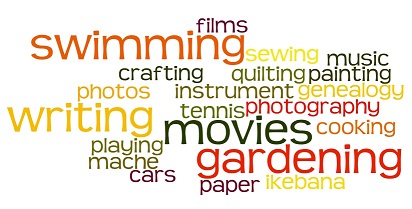
NUMBER FOUR: Hobbies and Interests

Source: Docdreyfus.com

I had to unlearn a BBA’s worth of advice levied directly against this practice when I started applying for jobs, here. Further, non-academic American sources (like Business Insider) are positioned so strongly against it that they might actually hurt their readers’ chances in the international job market. Truth is, American companies will try to learn this about you in the interview and presumably find it distracting during  a resume review session. They’re just trying to find out if you can hurdle the acceptable-competence bar when they look at your CV. So I’ve heard and read, anyway. Not so for German companies.

According to the advice I’ve been given, German companies want to know if you’re interesting even before they speak to you in person. It might be* that recruiters like to have personal questions ready before they see you. Maybe it’s considered too frank if you ask someone you’ve just met what they like to do in their spare time, and this gives them a polite path into that conversation. Another theory in which I have far more confidence is that German companies and employees really, really value a balance between work and the rest of life. They want to know that you’re not a workaholic before they entertain recruiting you. My confidence in this theory comes from what I’ve learned about the German perception of working late. It’s usually perceived negatively, as an indication that you didn’t work efficiently enough during the day. Want to experience this norm for yourself? Ask an employed German how many holidays they took last year, and notice how proud they look as they struggle to remember what their office looks like.

And what happens in the States when you’re the guy or girl who always leaves exactly at the 8-hour mark? Or God forbid, sooner? Your workplace will compare you to your office-dwelling, late-working coworkers and consider you comparatively unenthusiastic and unambitious. Want to experience this norm for yourself? Ask an employed American how many hours they worked last month, and notice how proud they become as they tell you what lunch at one’s desk is like (they’ll act like they’re complaining, though).

*Why I’m so unsure: My research into the matter (Googling “why hobbies and interests on my CV?” and the like) is only returning outrageously ethnocentric articles entitled “Things You Should NEVER EVER Include on Your CV.” Outrageous.

NUMBER FIVE: References

This is where we tear down the “be honest” tip we got from the old days in the U.S.

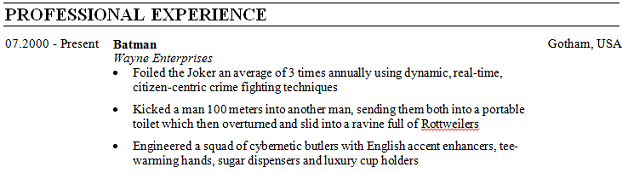
German companies have their own ways of figuring out we're lying.
German companies have their own ways of figuring out we’re lying.

American companies sometimes ask for “references,” as well. But, it means something quite different than it does, here. In American, “reference” means contact information. You list 3-5 people at the end of your CV and, alongside each, you mention the nature of your relationship and add their phone number and e-mail address. A potential employer, upon seeing your references, will call one or a few or all of them to verify that you worked with them and ask about your personality. You should be honest on your CV, because your next employer might call one of your old ones and find out if you’re lying (not to mention dishonest CVs are the mark of a true dirtbag).

Here, a “reference” is a very specific kind of document that German employers give their employees when they leave the company. The document confirms your employment dates and even includes an appraisal of your skills and personality. A friend told me today that these appraisals will always sound either neutral or positive, but negativity may abound within. For instance, one might say something like “Hard working and devoted–routinely worked long hours to make sure the job was done.” It sounds like a generous appraisal of someone’s work ethic, but what it means is that they think you manage your life poorly. It’s a red flag to the new employer that you take a long time to finish your work.

The implication here is that candidates don’t even have the option of being dishonest, because each is expected to submit a backup CV written by each previous employer. It’s an interesting step that seems extraneous from an American’s completely American perspective. I remember an undergrad classmate of mine getting blacklisted from Wall Street, because he lied and claimed an internship on his resume that he never actually had. Perhaps vetting him required an investment of time that German firms consider a waste, though. After all, if the background check comes with the CV, HR can spend its time doing other valuable things.

The final interesting thing about references is that American companies simply don’t provide the German version. In fact, my old employers have policies that disallow sharing of any information other than confirmation that you worked for them. They can’t comment on their employees’ personalities or competencies, even if the new employer calls them and asks. It would seem that companies here are understanding about this, though, as I’ve been granted my first interview next Monday.

There you have it: 5 ways composing a CV in Germany is weird to an American. What do you think? Did anything surprise you? Did I leave any weirdness out? How does this list compare to what other countries want in a CV? Light up the comment section; I look forward to the discussion.

I Ain’t No Chicken, Turkey

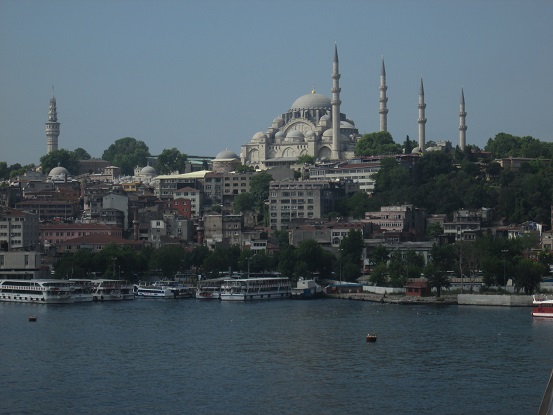
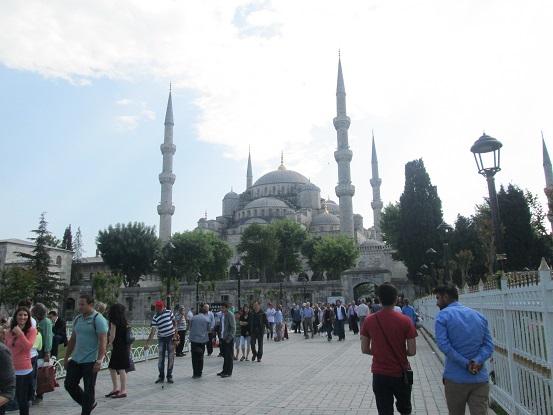
Walking across a bridge from our hotel to the historical district, we see the Suleymaniye mosque.

Roxana and I have wanted to visit Turkey for a long time. We couldn’t find any talking ones, though, so we settled on visiting the country for a weekend instead.

Ha.

Anyway, we visited Istanbul, and it’s a very, very cool city. On a scale from Michael Scott to uncle Jesse, Istanbul ranks a solid Vincent Chase.

Show me a city that ranks "Uncle Jesse," and I'll tell Elon Musk that he lost the race to Mars.
Show me a city that ranks “Uncle Jesse,” and I’ll tell Elon Musk that he lost the race to Mars.
"Hey man, I'm Istanbul. What's goin' on?"
“Hey man, I’m Istanbul. What’s goin’ on?”
"Wassaaaah, brahs? Name's Hoboken. Clickety clack!"
“Wassaaaah, brahs? Name’s Hoboken. Clickety clack!”

I expected it to be pretty close to completely normal, since I’ve been told that Istanbul is absolutely crawling with tourists all of the time. Surprisingly, though, it was a much weirder time than I expected. Weird, of course, is a good thing.

Anyway, since it was our first time there, and we were there only for a weekend, what I offer here is a description of the way Istanbul feels as a tourist. Specifically, I’m going to tell you that there are a ton of people in Istanbul, and that there are some cool things to do there. In that order.

The Friend Factor

You’re friendly, right? Eh, we all are. Put one of us in a room full of people–the more people in the room, the more friends we’ll have at the end of the night. Shrink that room and we’ll just make those friends all the faster. Life is super duper.

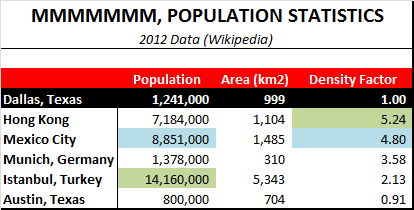
What if someone were to put us in an Istanbul full of 14 million people? That’s the kind of question we here at the Bittesuite like to answer with our patented Friend Facto-

Okay, you got me. The friend factor just compares population density from city to city. Population statistics go down easier with a bit of rich cheese poured over the top, don’t you think?

Below is a list of density factors, prepared much like what I displayed in my post about Mexico City. They just relate the crowd in each city to the normal crowd in Dallas, Texas. On the weekend. Not during a weekday, when 20 cities outside of Dallas feed it a workforce.

Shut your blog hole and tell me about Istanbul, already!

Never been to Dallas, so this is stupid? Not for long! Imagine a weekend in Dallas. You wake up on Saturday to the sound of either birds or nothing outside your window. During the day, you’ll drive to the store and stop only for red lights and stop signs. Maybe you’ll take a walk around the uptown area–plenty of people will also be walking around, but very few people will be in your way. For dinner you go to a casual uptown restaurant without reservations, and you’re probably able to eat there. All of this is possible in spite of the worst local mass transit system on the planet.

You suck. (Source: dallassouthnews.com)
You suck.
(Source: dallassouthnews.com)

Then, you take a trip to Istanbul, and the number of people per square kilometer is more than twice what it was in Dallas. Yowzah. That’s what this table says.

Seriously, Munich?????

Main Street

We spent the entire Saturday walking around the entire Istanbul, and I can now say with authority that there are a ton of people in that city. Crossing a street means waiting for someone confident-looking to pick an appropriately sized gap in traffic so they can drag you to safety with their coattails. Speaking of traffic, I think the average car in Istanbul at any given point in time is moving at 10 miles per hour. If you’re a woman, finding a seat on a train is possible. If you’re a man, prepare to stand like it’s your pastime (giving up your seat to women and the elderly might be the most easily recognizable cultural norm in the city). Finding a place to eat, however, is remarkably easy, but that’s probably due to what I estimate to be a 2:1 restaurant-to-person ratio. Normal streets are packed full of people. However, walking down them is totally fine, because Istanbul is awesome: people move like they’re actually going somewhere. Very little aimless meandering in Istanbul, is what I’m trying to say.

There are Some Cool Things to do in Istanbul

Now, about that walking I mentioned. In one day, we hit the Sultan Ahmet (“Blue Mosque”), the Yeni (“New Mosque”), the Basilica Cistern, Topkapi Palace, Galata Tower, Taksim Square, Istiklal Street, the Grand Bazaar, and the Spice Bazaar. Because we did so much in one day, we didn’t have much time to dwell on the historical significance of each landmark. However, we did learn a little (I’m not going to fill in the gaps with Google research, so you can know what kind of depth one might sacrifice during such a broad visit):

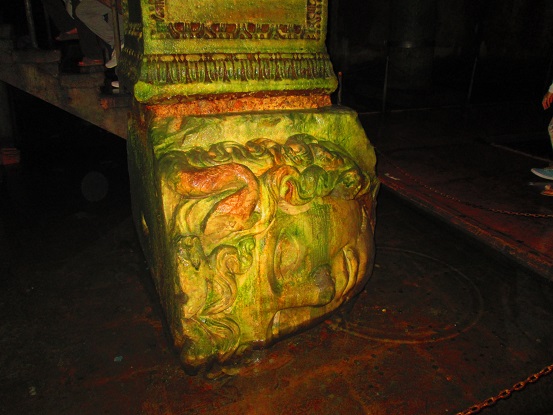
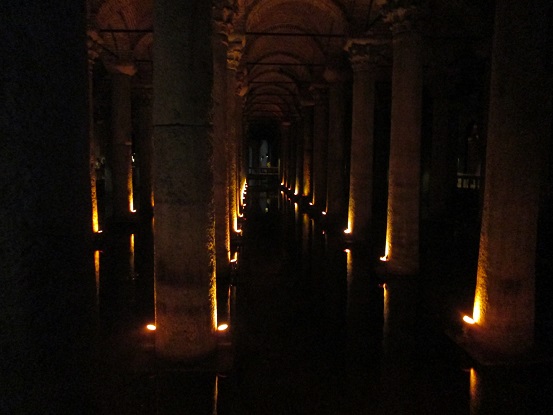
1) The Basilica Cistern is a relic of Roman occupation. It stored water for the city, like a normal cistern, except there are two weird Medusa heads carved into two pillars near the back of it. Mysterious.

Why are you here, Medusa head?
I swear there's a secret passage to the Ark of the Covenant in there, somewhere.
I swear there’s a secret passage to the Ark of the Covenant in there, somewhere.

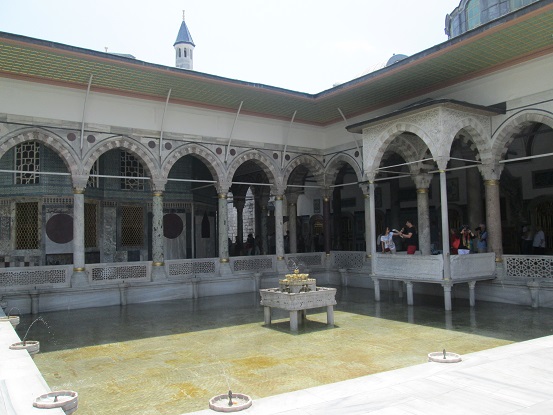
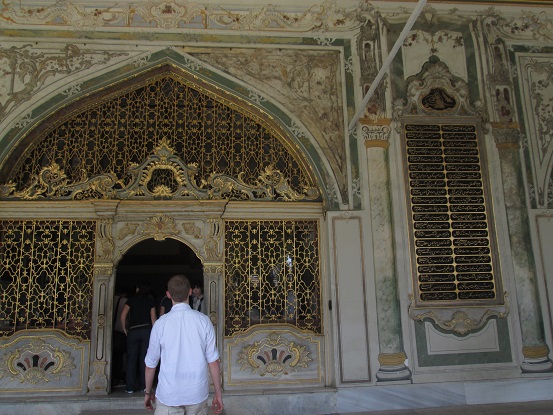
2) The Topkapi Palace was owned by a person during an era of some sort. Now, it’s a museum to that person’s lifestyle and that era’s materialism and mentality for war. We learned, for instance, that curved swords were easier to wield quickly than straight swords, and the Ottoman armies preferred quick slashes to blunt slicing and thrusting. We also viewed rooms full of golden- and jeweled things. They also let you walk around in the palace’s harem–the building where the owner kept his wives and concubines. And finally, we walked out to a flower garden overlooking the city, but I had to turn around and leave immediately; standing in that garden rendered me completely blind. It might be because the floor and walls were white rock, or maybe the garden is a holy refuge and I’m a demon. I did hiss and moan a bit of Latin heresy when the bright light flooded my vision.

Topkapi Palace
Topkapi Palace
The Palace beckons.
The Palace beckons.

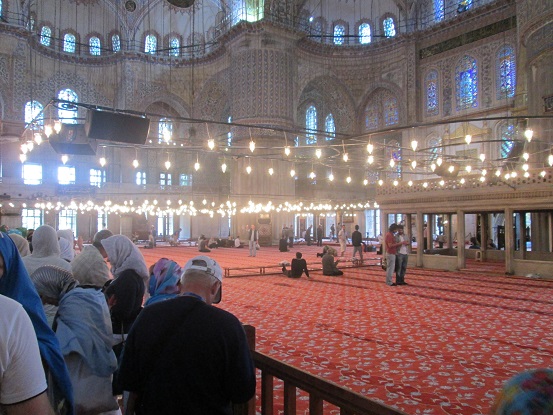
3) Sultan Ahmet (Blue Mosque) is the big daddy mosque that plays host to all of us tourists. It’s the one you can enter as an ignorant boob without getting into trouble, because they’ve prepared for your ignorant boobness. For instance, you have to wear long pants and a sleeved shirt as a man. Of course I wore shorts. It’s okay, though, because they offer you a long blue skirt of sorts that you wrap around yourself over your shorts in place of long pants. Women also need to cover their arms and legs, but in addition they need to cover their heads. The mosque’s hosts provide head coverings. Once inside, we were able to look around. Muslim men pray in the front of the mosque. We tourists walked around behind the men. Muslim women prayed behind us.

Inside Sultan Ahmet ("Blue Mosque")
Inside Sultan Ahmet (“Blue Mosque”)
Not quite as blue as the name implies.

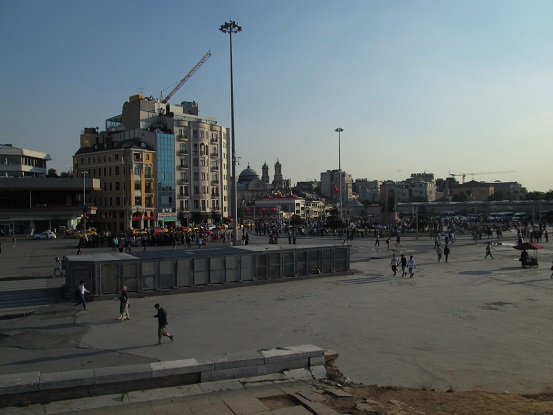
4) Taksim Square is an open area at one end of Istiklal Street. It’s where last year’s and this year’s famous demonstrations occurred. It’s a pretty plaza.

Taksim Square. This year's demonstration would take place just a few days after this.
Taksim Square. This year’s demonstration would take place just a few days after this.

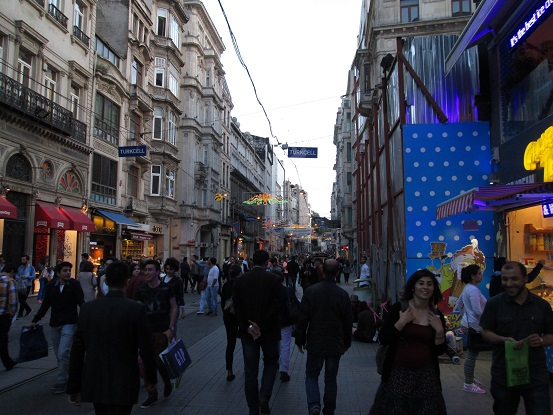
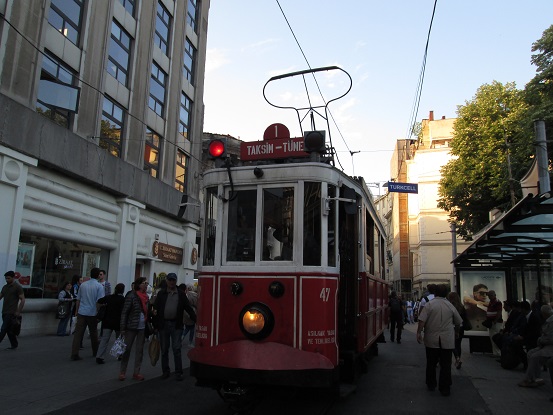
5) Istiklal Street is where you find tons of conventional shopping and dining. The city is incredibly light on alcohol, but Istiklal offers restaurants that serve it. Otherwise, the western European influence is extremely evident: it looks just like a commercial street you would find in Amsterdam, or like Kaufingerstraße in Munich.

Serious Theory: That tram's job is pushing people out of the way.
Serious Theory: That tram’s job is pushing people out of the way.
Istiklal Street
Istiklal Street

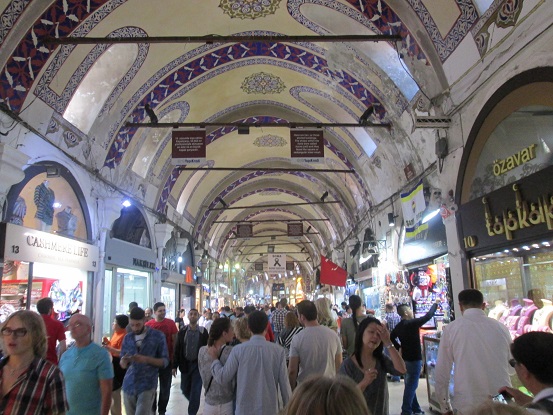
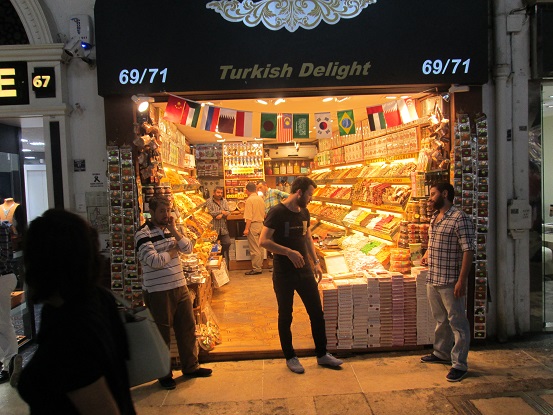
6) The Grand Bazaar and the Spice Bazaar were major trade hubs a long time ago, I think. I think I remember learning when I was younger that western Europeans many many years ago would travel through Istanbul on their way eastward. They would stop and marvel at the foreign spices and wares sold at these markets, and then maybe go home to tell their bros how awesome it was. I’m trying my hardest not to Google this right now. My point is that we were able to learn very, very little about the history of these Bazaars while we were there, although the city might offer that information through some channel that we didn’t find. Today, you move through its giant hallways past throngs of shoppers, perfume stores, clothing stores, and shops that sell special candies generally called “Turkish Delight.”

This is the Grand Bazaar
This is the Grand Bazaar (Not Pictured: Spice Bazaar)
Turkish Delight. Delicious, delicious candies.

Accepted

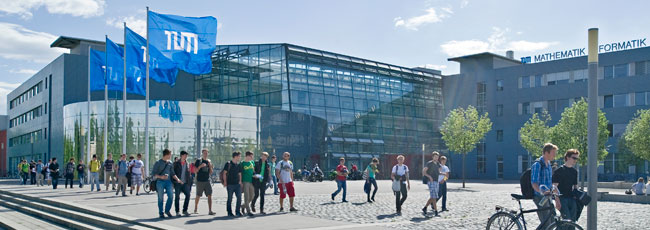
TUM MunichAbout a year ago, I arrived in Munich, noticed a really interesting-looking Master’s program at a local university, applied for the program (incidentally, the only program whose deadline hadn’t yet passed), and was rejected for reasons unknown. A Master in Logic and The Philosophy of Science would have been extremely interesting, but as it seems, there are other types of people who are better fits in such a program. Afterward, I laid out the state of my drawing board and resolved to finish learning German before applying to a new Master’s program “next year.”

I began looking at other universities in the area. One is the Munich Business School (MBS)–a place where you go to get an International MBA for approximately one trillion euros per semester. The MBA is a degree that doesn’t quite grant what I need from an education, though. Most public among their benefits are that they offer title recognition (“MBA” is a powerful acronym on a CV), really good networking opportunities, and an environment conducive to learning through discussion of professional experience. The last one, admittedly, is really cool. However, the other two are benefits that I believe I can get elsewhere if I’m a little creative about it.

The Munich University of Applied Sciences and the Ludwig Maximillian University of Munich are two others with English-taught Masters programs. They both emphasize two types of programs (in their English catalogue):

1) Technical Programs: Programs in which you learn how to do something very concrete. Examples are software engineering and bioinformatics.

2) Niche business/strategy/management programs: Programs in which you learn to apply business strategy concepts in esoteric contexts. Examples are social care management and management in the hospitality industry.

Software development is definitely in my future, so a technical program is appealing on some level. But, I feel I don’t need a university education to reap the benefits of a technical program. It seems to me that the core offering of a university education in a technical field is a structured learning environment–guided practice, homework, a teacher telling you what you should learn and when. If structured learning environment is not at the core of what you’re seeking, however, then one can develop a technical skill through YouTube, Lynda, Missing Manuals and SaaS platforms like the Unreal Engine, albeit maybe more slowly. What really matters in the technical fields that interest me is the portfolio which the education services.

The other type of program–niche business/strategy/management programs–seem to be pigeon holes that require a lot of certainty in one’s destiny. If I were to go into social care management, for example, I would learn how what I learned in undergrad is relevant to a comparatively narrow professional field. That means that what the program primarily offers is information related to that comparatively narrow professional field–problems the field has to solve, or the structure of a business in the field, for examples. If I were certain that “social care management” is where I want to make my difference, then a program as narrowly tailored as that one might give me a boost.

LMU and MUAS were just a little outside of my consideration set, then (outside LMU’s Logic and the Philosophy of Science program).

TUM FreisingWhat I was looking for was a program that develops skill applicable to a broad set of disciplines (analysis, synthesis, human behavioral research, logical argument, engaging speaking…) at  a much deeper, more intense level than my undergraduate programs did. I was looking for philosophical challenge, intellectual challenge and a chance to rethink and develop my values. I was looking for marketing leadership in 5 years, entrepreneurial leadership in 15, and the intellectual versatility to make deciding where I apply myself an option.
What I found a little less than a year ago is the Master in Consumer Affairs program (MCA) at the Technischen Universität München (TUM).

At the most basic level, MCA teaches marketing skills, using European Union public policy to give the skills context in which to be practiced. In fact, the program was created at the request of the European Commission, and they remain its official supporter. The program offers what I’m after in the following ways:

1) The marketing skill it emphasizes above all others is behavioral research–figuring out why consumers do what they do. The entire Marketing discipline is two words: discover and satisfy. As half of the definition of marketing, behavioral research is an extremely important skill for me in my quest to business leadership.

2) Honing skill in behavioral research necessarily means honing skill in analysis and synthesis, the two most advanced intellectual skills people currently develop (the other two being memorization and application). Conducting market research always culminates in breaking down findings (analysis), reaching conclusions and generating a marketing course of action (synthesis). Analysis and synthesis are at the center of my drive to self improvement, so their involvement in the MCA education make me very excited.

EU Commission Logo3) The EU Public Policy context of the program is the source of the philosophical challenge and value development I’m after. As I wrote my entrance essay, one conclusion I reached about the EU is that the EU Commission seem to be of minds that favor experimentation in social change. They pass directives (strong legal suggestions to member nations) and regulations (legal mandates to member nations) rather frequently in the realm of consumer affairs. These measures and their relatively frequent revisions represent pondering that I really admire: What does it mean to enjoy free speech? How free should speech be? How responsible are consumers for their own well-being? Should companies be able to push social agendas with their marketing? Should companies have to push social agendas with their marketing? The EU Commission is overseeing the cultural, political and economic merging of a large and extremely diverse region of the world. This puts it in a position to (read: forces it to?) question many of the values longer-established world regions take for granted. Tasty ideological challenges await.

I’m going to stop here, for now. Long story short, though, TUM accepted me into the MCA program last Thursday, and I’m really excited about it. My next few posts will cover what the application process was like, what preparing for school is like, and maybe a few of the more dramatic moments in the past few months. If you’re thinking about getting a Master’s degree in Munich, or are just curious, then I look forward to seeing you again, soon.